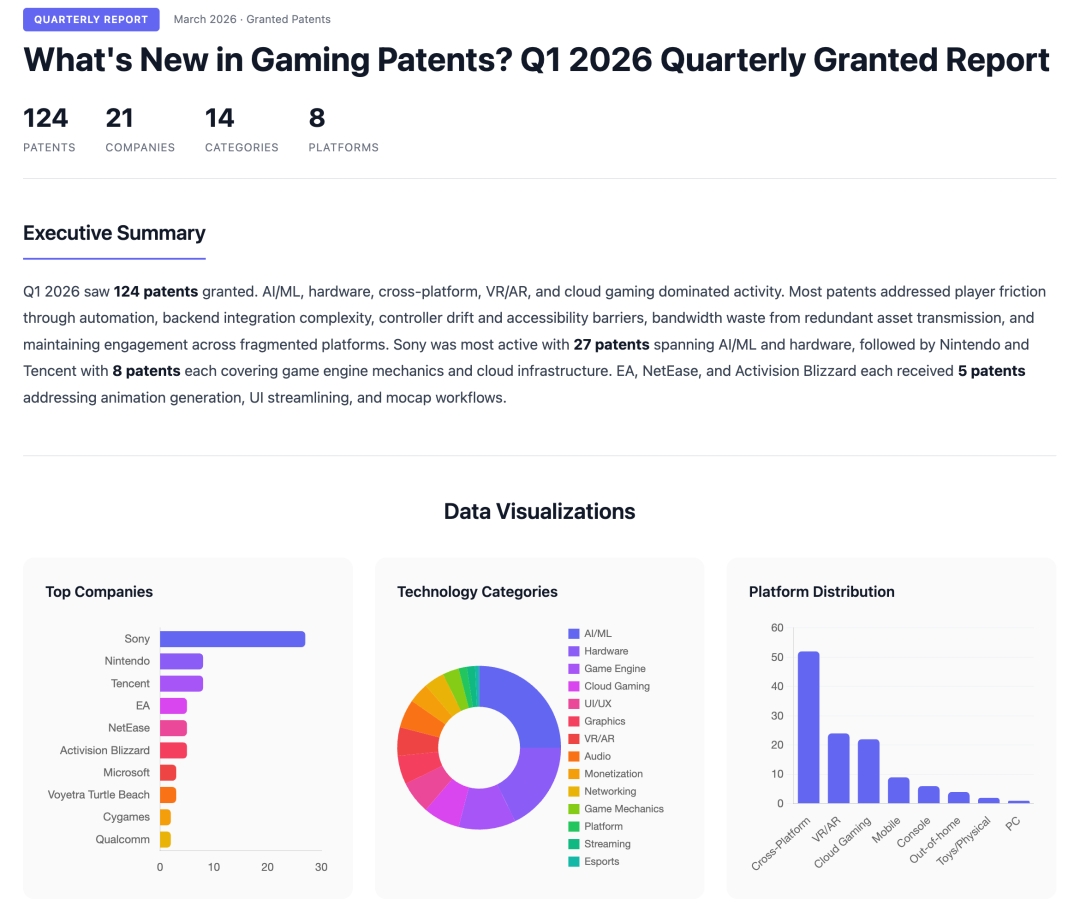
PRAGUE, CZECH REPUBLIC - Apr 8, 2026 - Future of Gaming, the strategic intelligence platform tracking gaming patents from the USPTO, has published its Q1 2026 Quarterly Granted Report analyzing 124 patents awarded to 21 companies. The report reveals a consistent industry priority: eliminating player friction through automation, from controller drift calibration to backend service integration to crafting systems that don't pull players out of the game world.
"The granted patents tell you what's actually shipping," said Alex Kirillov, founder of Future of Gaming. "Filed patents show intent. Granted patents show commitment. When Sony gets 27 grants in a single quarter spanning everything from gesture recognition to spatial anchoring to procedural animation, that's not speculative R&D. That's infrastructure for products in development right now."
Key Findings
Sony received more than triple the next-largest company. Sony's 27 granted patents span six categories, with 16 in AI/ML alone. Their grants cover gesture recognition that prevents false positives during gameplay, spectator-driven AI adjustment, session duration prediction, customizable flat controllers for accessibility, and spatial anchoring for mixed-reality experiences.
Cross-platform led granted patents with 52. Unified progression tracking, backend service integration, and multi-game loyalty systems dominated. Betty Gaming received a patent for universal progress bars converting game-specific metrics into platform-wide rewards. Amazon patented pre-configured workflows connecting authentication, matchmaking, leaderboards, and voice chat without custom integration code.
AI/ML accounted for 31 grants. EA's Motion Variational Autoencoders generate character poses in real-time without storing animation data. Cygames patented automated bug detection for collectible card games by comparing irregular and regular gameplay session logs. Colopl received a patent for AI-generated NPC dialogue replacing scripted responses.
Hardware grants focused on accessibility and durability. Sony received patents for adaptive dead-zone calibration, touch-sensitive control surfaces, and customizable flat controllers. Wi-Charge patented laser-based wireless charging for controllers during active gameplay. Backbone Labs received two grants for portable controller hardware.
Cloud gaming patents targeted loading screens and server costs. Tencent received patents for caching reusable 3D assets across scenes and using AI-based image recognition to automate game updates across thousands of cloud instances. Google patented predictive asset pre-fetching during level transitions. Hangzhou Electronic Soul developed dynamic MMO scene merging that consolidates underpopulated instances automatically.
VR/AR received 24 grants. Sony patented systems that identify consoles and TVs in physical rooms as persistent spatial reference points for mixed-reality. Apple received a patent for centralized motion planners adapting movement to diverse virtual characters. Vsn Vision patented XR control systems capturing biometrics with gameplay mechanics incentivizing data sharing.
Company Strategies
Sony (27 patents, 6 categories) concentrated heavily in AI/ML with 16 grants covering contextual input acceptance, game state inference, session prediction, and spectator-driven gameplay. Hardware patents addressed controller drift, accessibility, and pre-touch detection. Their recurring theme: using machine learning to interpret ambiguous player inputs correctly.
Nintendo (8 patents, 2 categories) focused on game engine mechanics, receiving five grants for equipment fusion without menu screens, building construction using standard character actions, and waypoint-based exploration with integrated lighting and fast-travel. Their approach keeps players inside the game world rather than pulling them into menus.
Tencent (8 patents, 4 categories) spread grants across cloud gaming, streaming, monetization, and other areas. Cloud patents addressed bandwidth waste and server maintenance automation. Their streaming patent covered interactive virtual characters responding to gameplay events automatically, addressing the split-attention problem streamers face between playing and engaging audiences.
EA (5 patents, 2 categories) received grants for Motion Variational Autoencoders generating real-time character animation and geometric environment analysis for contextual player assistance. These eliminate massive storage requirements for predetermined animation sequences.
Activision Blizzard (5 patents, 1 category) concentrated entirely in game engine with four grants for LED wall motion capture systems. These display different virtual backgrounds per actor perspective simultaneously, solving the limitation of traditional green screens where actors cannot see the game elements they're reacting to.
NetEase (5 patents, 2 categories) received grants for unified cosmetic display and purchase interfaces, batch quest execution, and suspicion value tracking in stealth games. Their UI patents target purchase conversion by reducing the number of screens between browsing and buying.
Emerging Themes
The report identifies five cross-company themes:
AI-driven character behavior (8 patents, 5 companies). Sony, EA, Nintendo, Colopl, and ByteDance all received grants for systems making NPCs more responsive and less repetitive, from gesture-aware input systems to real-time animation generation to crowd imitation mechanics.
Personalized monetization (7 patents, 4 companies). Sony, Tencent, NetEase, and Cygames received grants for purchase recommendations based on similar players, skill-based seasonal rewards, and social assistance systems that notify friends when players struggle.
Streaming and spectator enhancement (6 patents, 4 companies). Sony, Tencent, Netflix, and Nvidia received grants for automated esports camera angles, interactive stream overlays, multi-modal touchscreen feedback, and paused-frame quality refinement.
Server resource optimization (5 patents, 4 companies). Hangzhou Electronic Soul, Google, Amazon, and Sony received grants addressing underpopulated instance consolidation, predictive pre-fetching, pre-configured backend workflows, and session duration prediction.
Time-constrained gameplay (4 patents, 3 companies). Nintendo, NetEase, and Activision Blizzard received grants for waypoint exploration systems, batch quest execution, and algorithmic content editing that fits game segments into available play windows.
Report Access
The full Q1 2026 Quarterly Granted Report, including detailed technology trend analysis, platform distribution breakdowns, company strategy sections, and emerging theme identification, is available at futureofgaming.com/publications.
Future of Gaming publishes quarterly reports covering all gaming patent activity alongside twice-weekly patent analyses, monthly reports with company rankings and technology trends, and real-time trend tracking across 14 technology categories.
Media Contact
Company Name: Future Of Gaming
Contact Person: Alex Kirillov
Email: Send Email
Country: Czech Republic
Website: https://futureofgaming.com