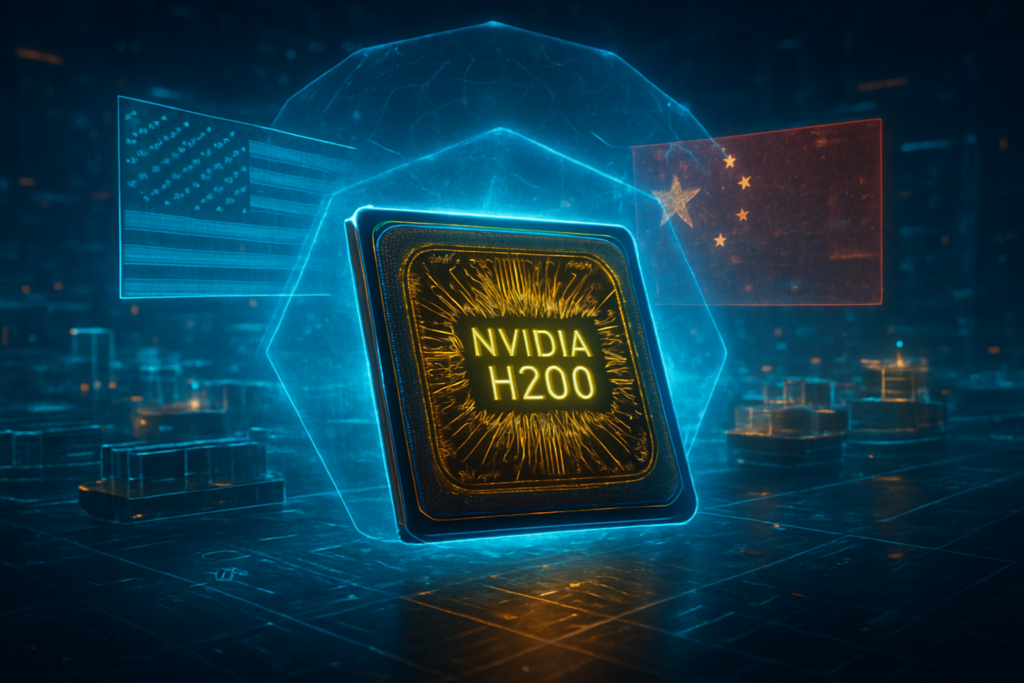
In a month defined by unprecedented policy pivots and high-stakes brinkmanship, the global semiconductor market has been plunged into a state of "logistical limbo." On January 14, 2026, the Trump administration shocked the tech world by granting NVIDIA (NASDAQ: NVDA) a formal license to export the H200 Tensor Core GPU to China—a move that initially signaled a thawing of tech tensions but quickly revealed itself to be a calculated economic maneuver. By attaching a mandatory 25% "Trump Surcharge" and rigorous domestic safety testing requirements to the license, the U.S. has attempted to transform its technological edge into a direct revenue stream for the Treasury.
However, the "thaw" was met with an immediate and icy "freeze" from Beijing. Within 24 hours of the announcement, Chinese customs officials in Shenzhen and Hong Kong issued a total blockade on H200 shipments, refusing to clear the very hardware their tech giants have spent billions to acquire. This dramatic sequence of events has effectively bifurcated the AI ecosystem, leaving millions of high-end GPUs stranded in transit and forcing a reckoning for the "Silicon Shield" strategy that has long underpinned the delicate peace between the world’s two largest economies.
The Technical Trap: Security, Surcharges, and the 50% Rule
The NVIDIA H200, while recently succeeded by the "Blackwell" B200 architecture, remains the gold standard for large-scale AI inference and training. Boasting 141GB of HBM3e memory and a staggering 4.8 TB/s of bandwidth, the H200 is specifically designed to handle the massive parameter counts of the world's most advanced large language models. Under the new January 2026 export guidelines, these chips were not merely shipped; they were subjected to a gauntlet of "Taxable Dependency" conditions. Every H200 bound for China was required to pass through independent, third-party laboratories within the United States for "Safety Verification." This process was designed to ensure that the chips had not been physically modified to bypass performance caps or facilitate unauthorized military applications.
Beyond the technical hurdles, the license introduced the "Trump Surcharge," a 25% fee on the sales price of every unit, payable directly to the U.S. government. Furthermore, the administration instituted a "50% Rule," which mandates that NVIDIA cannot sell more than half the volume of its U.S. domestic sales to China. This ensures that American firms like Microsoft (NASDAQ: MSFT) and Alphabet (NASDAQ: GOOGL) maintain clear priority access to the best hardware. Initial reactions from the AI research community have been polarized; while some see this as a pragmatic way to leverage American innovation for national gain, others, like the Open Compute Project, warn that these "managed trade" conditions create an administrative nightmare that threatens the speed of global AI development.
A Corporate Tug-of-War: NVIDIA Caught in the Crossfire
The fallout from the Chinese customs blockade has been felt instantly across the balance sheets of major tech players. For NVIDIA, the H200 was intended to be a major revenue driver for the first quarter of 2026, potentially recapturing billions in "lost" Chinese revenue. The blockade, however, has paralyzed their supply chain. Suppliers in the region who manufacture specialized circuit boards and cooling systems specifically for the H200 architecture were forced to halt production almost immediately after Beijing "urged" Chinese tech giants to look elsewhere.
Major Chinese firms, including Alibaba (NYSE: BABA), Tencent (HKEX: 0700), and ByteDance, find themselves in an impossible position. While their engineering teams are desperate for NVIDIA hardware to keep pace with Western breakthroughs in generative video and autonomous reasoning, they are being summoned by Beijing to prioritize "Silicon Sovereignty." This mandate effectively forces a transition to domestic alternatives like Huawei’s Ascend series. For U.S.-based hyperscalers, this development offers a temporary strategic advantage, as their competitors in the East are now artificially capped by hardware limitations, yet the disruption to the global supply chain—where many NVIDIA components are still manufactured in Asia—threatens to raise costs for everyone.
Weaponizing the Silicon Shield
The current drama represents a fundamental evolution of the "Silicon Shield" theory. Traditionally, this concept suggested that Taiwan’s dominance in chip manufacturing, led by Taiwan Semiconductor Manufacturing Company (NYSE: TSM), protected it from conflict because a disruption would be too costly for both the U.S. and China. In January 2026, we are seeing the U.S. attempt to "weaponize" this shield. By allowing exports under high-tax conditions, the Trump administration is testing whether China’s need for AI dominance is strong enough to swallow a "taxable dependency" on American-designed silicon.
This strategy fits into a broader trend of "techno-nationalism" that has dominated the mid-2020s. By routing chips through U.S. labs and imposing a volume cap, the U.S. is not just protecting national security; it is asserting control over the global pace of AI progress. China’s retaliatory blockade is a signal that it would rather endure a period of "AI hunger" than accept a subordinate role in a tiered technology system. This standoff highlights the limits of the Silicon Shield; while it may prevent physical kinetic warfare, it has failed to prevent a "Total Trade Freeze" that is now decoupling the global tech industry into two distinct, incompatible spheres.
The Horizon: AI Sovereignty vs. Global Integration
Looking ahead, the near-term prospects for the H200 in China remain bleak. Industry analysts predict that the logistical deadlock will persist at least through the first half of 2026 as both sides wait for the other to blink. NVIDIA is reportedly exploring "H200-Lite" variants that might skirt some of the more aggressive safety testing requirements, though the 25% surcharge remains a non-negotiable pillar of the Trump administration's trade policy. The most significant challenge will be the "gray market" that is likely to emerge; as the official price of H200s in China skyrockets due to the surcharge and scarcity, the incentive for illicit smuggling through third-party nations will reach an all-time high.
In the long term, experts predict that this blockade will accelerate China’s internal semiconductor breakthroughs. With no access to the H200, firms like Huawei and Biren Technology will receive unprecedented state funding to close the performance gap. We are likely entering an era of "Parallel AI," where the West develops on NVIDIA’s Blackwell and H200 architectures, while China builds an entirely separate stack on domestic hardware and open-source models optimized for less efficient chips. The primary challenge for the global community will be maintaining any form of international safety standards when the underlying hardware and software ecosystems are no longer speaking the same language.
Navigating the Decoupling
The geopolitical drama surrounding NVIDIA's H200 chips marks a definitive end to the era of globalized AI hardware. The Trump administration’s attempt to monetize American technological superiority through surcharges and mandatory testing has met a formidable wall in Beijing’s pursuit of silicon sovereignty. The key takeaway from this standoff is that the "Silicon Shield" is no longer a passive deterrent; it has become an active instrument of economic and political leverage, used by the U.S. to extract value and by China to signal its independence.
As we move further into 2026, the industry must watch for how NVIDIA manages its inventory of stranded H200 units and whether the "Trump Surcharge" becomes a standard model for all high-tech exports. The coming weeks will be critical as the first legal challenges to the Chinese blockade are expected to be filed in international trade courts. Regardless of the legal outcome, the strategic reality is clear: the path to AI dominance is no longer just about who has the best algorithms, but who can navigate the increasingly fractured geography of the chips that power them.
This content is intended for informational purposes only and represents analysis of current AI developments.
TokenRing AI delivers enterprise-grade solutions for multi-agent AI workflow orchestration, AI-powered development tools, and seamless remote collaboration platforms.
For more information, visit https://www.tokenring.ai/.