
Earnings results often indicate what direction a company will take in the months ahead. With Q1 behind us, let’s have a look at Jacobs Solutions (NYSE: J) and its peers.
The sector has historically benefitted from steady government spending on defense, infrastructure, and regulatory compliance, providing firms long-term contract stability. However, the Trump administration is showing more willingness than previous administrations to upend government spending and bloat. Whether or not defense budgets get cut, the rising demand for cybersecurity, AI-driven defense solutions, and sustainability consulting should benefit the sector for years, as agencies and enterprises seek expertise in navigating complex technology and regulations. Additionally, industrial automation and digital engineering are driving efficiency gains in infrastructure and technical consulting projects, which could help profit margins.
The 6 government & technical consulting stocks we track reported a mixed Q1. As a group, revenues were in line with analysts’ consensus estimates.
While some government & technical consulting stocks have fared somewhat better than others, they have collectively declined. On average, share prices are down 2.6% since the latest earnings results.
Jacobs Solutions (NYSE: J)
With a workforce of approximately 45,000 professionals tackling complex challenges from water scarcity to cybersecurity, Jacobs Solutions (NYSE: J) provides engineering, consulting, and technical services focused on infrastructure, sustainability, and advanced technology solutions.
Jacobs Solutions reported revenues of $2.33 billion, up 8.8% year on year. This print exceeded analysts’ expectations by 2%. Overall, it was a very strong quarter for the company with a beat of analysts’ EPS and revenue estimates.
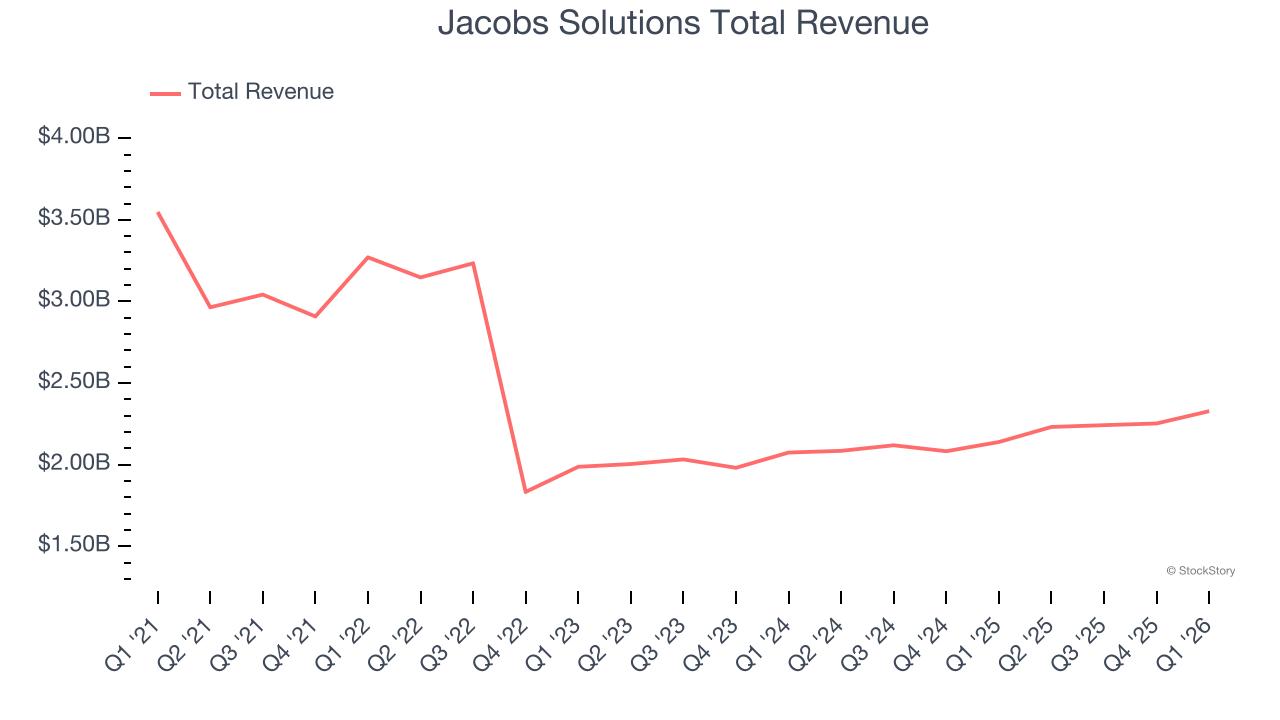
Jacobs Solutions pulled off the biggest analyst estimates beat and fastest revenue growth of the whole group. Investor expectations, however, were likely higher than Wall Street’s published projections, leaving some wishing for even better results (analysts’ consensus estimates are those published by big banks and advisory firms, not the investors who make buy and sell decisions). The stock is down 14.2% since reporting and currently trades at $117.11.
Is now the time to buy Jacobs Solutions? Access our full analysis of the earnings results here, it’s free.
Best Q1: UL Solutions (NYSE: ULS)
Founded in 1894 as a response to the growing dangers of electricity in American homes and businesses, UL Solutions (NYSE: ULS) provides testing, inspection, and certification services that help companies ensure their products meet safety, security, and sustainability standards.
UL Solutions reported revenues of $758 million, up 7.5% year on year, outperforming analysts’ expectations by 1.2%. The business had an exceptional quarter with a beat of analysts’ EPS and revenue estimates.
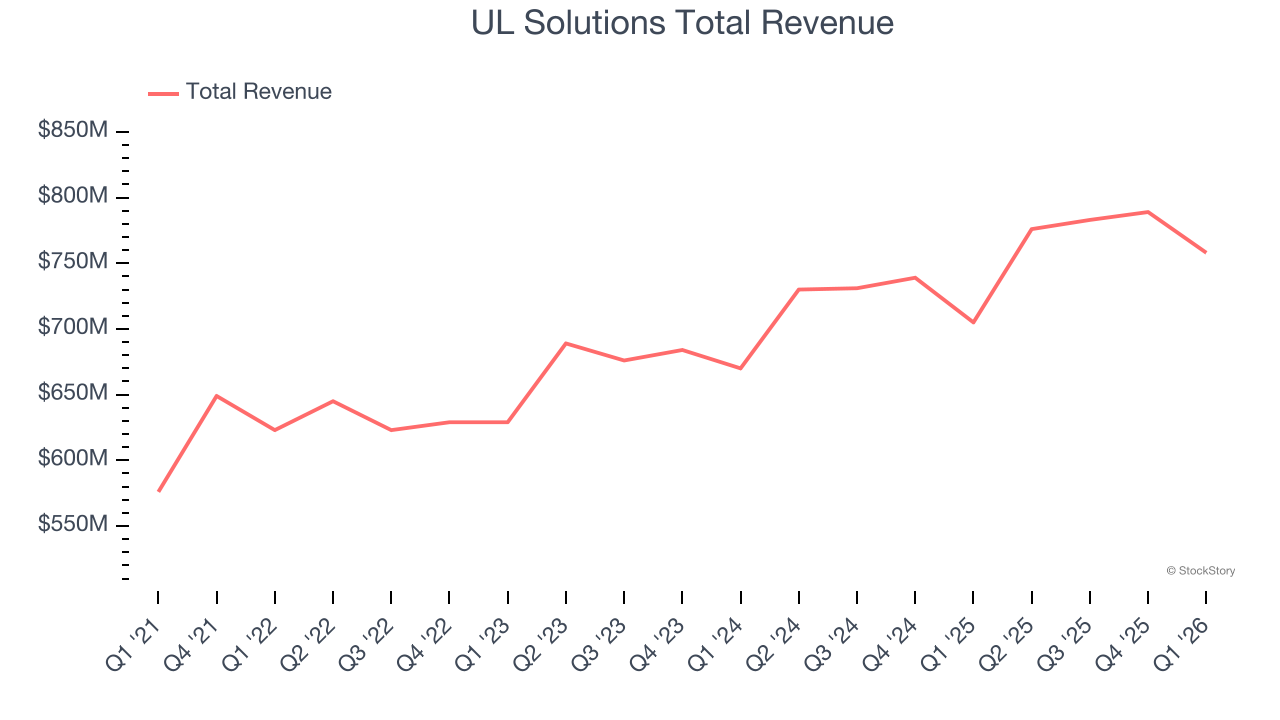
The market seems happy with the results as the stock is up 11.9% since reporting. It currently trades at $100.82.
Is now the time to buy UL Solutions? Access our full analysis of the earnings results here, it’s free.
Weakest Q1: Amentum (NYSE: AMTM)
With operations spanning approximately 80 countries and a workforce of specialized engineers and technical experts, Amentum Holdings (NYSE: AMTM) provides advanced engineering and technology solutions to U.S. government agencies, allied governments, and commercial enterprises across defense, energy, and space sectors.
Amentum reported revenues of $3.48 billion, flat year on year, in line with analysts’ expectations. It was a slower quarter as it posted a significant miss of analysts’ EPS estimates.
As expected, the stock is down 4.2% since the results and currently trades at $22.95.
Read our full analysis of Amentum’s results here.
ICF International (NASDAQ: ICFI)
Operating at the intersection of policy, technology, and implementation for over five decades, ICF International (NASDAQ: ICFI) provides professional consulting services and technology solutions to government agencies and commercial clients across energy, health, environment, and security sectors.
ICF International reported revenues of $437.5 million, down 10.3% year on year. This print came in 2.5% below analysts' expectations. Overall, it was a slower quarter as it also logged a significant miss of analysts’ revenue and EPS estimates.
ICF International pulled off the highest full-year guidance raise but had the slowest revenue growth among its peers. The stock is down 8.5% since reporting and currently trades at $68.20.
Read our full, actionable report on ICF International here, it’s free.
Booz Allen Hamilton (NYSE: BAH)
With roots dating back to 1914 and deep ties to nearly all U.S. cabinet-level departments, Booz Allen Hamilton (NYSE: BAH) provides management consulting, technology services, and cybersecurity solutions primarily to U.S. government agencies and military branches.
Booz Allen Hamilton reported revenues of $2.78 billion, down 6.4% year on year. This number missed analysts’ expectations by 2.8%. More broadly, it was a mixed quarter as it also recorded a beat of analysts’ EPS estimates but a significant miss of analysts’ revenue estimates.
Booz Allen Hamilton had the weakest performance against analyst estimates among its peers. The stock is up 4.1% since reporting and currently trades at $79.46.
Read our full, actionable report on Booz Allen Hamilton here, it’s free.
Market Update
Late in 2025 into early 2026, there was hand wringing around artificial intelligence. For software companies, the fear was that AI would erode pricing power and compress margins as new tools made it easier to replicate what once required expensive enterprise platforms. Crypto investors had their own version of the same anxiety: if AI agents could trade, allocate capital, and manage wallets autonomously, what exactly was the long-term value of today’s crypto infrastructure?
These concerns triggered a noticeable rotation away from these sectors and into safer havens. But markets rarely dwell on one narrative for long. Spring 2026 came, and the focus shifted abruptly from technological disruption to geopolitical risk. The US’ conflict with Iran became the dominant driver of market psychology, and when geopolitics takes center stage, the script changes quickly. Investors stop debating growth rates and start worrying about oil supply, inflation, and global stability.
Want to invest in winners with rock-solid fundamentals? Check out our Strong Momentum Stocks and add them to your watchlist. These companies are poised for growth regardless of the political or macroeconomic climate.
StockStory’s analyst team — all seasoned professional investors — uses quantitative analysis and automation to deliver market-beating insights faster and with higher quality.