Let’s dig into the relative performance of First Busey (NASDAQ: BUSE) and its peers as we unravel the now-completed Q3 regional banks earnings season.
Regional banks, financial institutions operating within specific geographic areas, serve as intermediaries between local depositors and borrowers. They benefit from rising interest rates that improve net interest margins (the difference between loan yields and deposit costs), digital transformation reducing operational expenses, and local economic growth driving loan demand. However, these banks face headwinds from fintech competition, deposit outflows to higher-yielding alternatives, credit deterioration (increasing loan defaults) during economic slowdowns, and regulatory compliance costs. Recent concerns about regional bank stability following high-profile failures and significant commercial real estate exposure present additional challenges.
The 87 regional banks stocks we track reported a slower Q3. As a group, revenues were in line with analysts’ consensus estimates.
In light of this news, share prices of the companies have held steady as they are up 1.7% on average since the latest earnings results.
First Busey (NASDAQ: BUSE)
Tracing its roots back to 1868 during America's post-Civil War reconstruction era, First Busey (NASDAQ: BUSE) is a bank holding company that provides commercial and retail banking, wealth management, and payment technology solutions across Illinois, Missouri, Florida, and Indiana.
First Busey reported revenues of $194.3 million, down 1.2% year on year. This print fell short of analysts’ expectations by 0.5%. Overall, it was a slower quarter for the company with a significant miss of analysts’ EPS estimates and net interest income in line with analysts’ estimates.
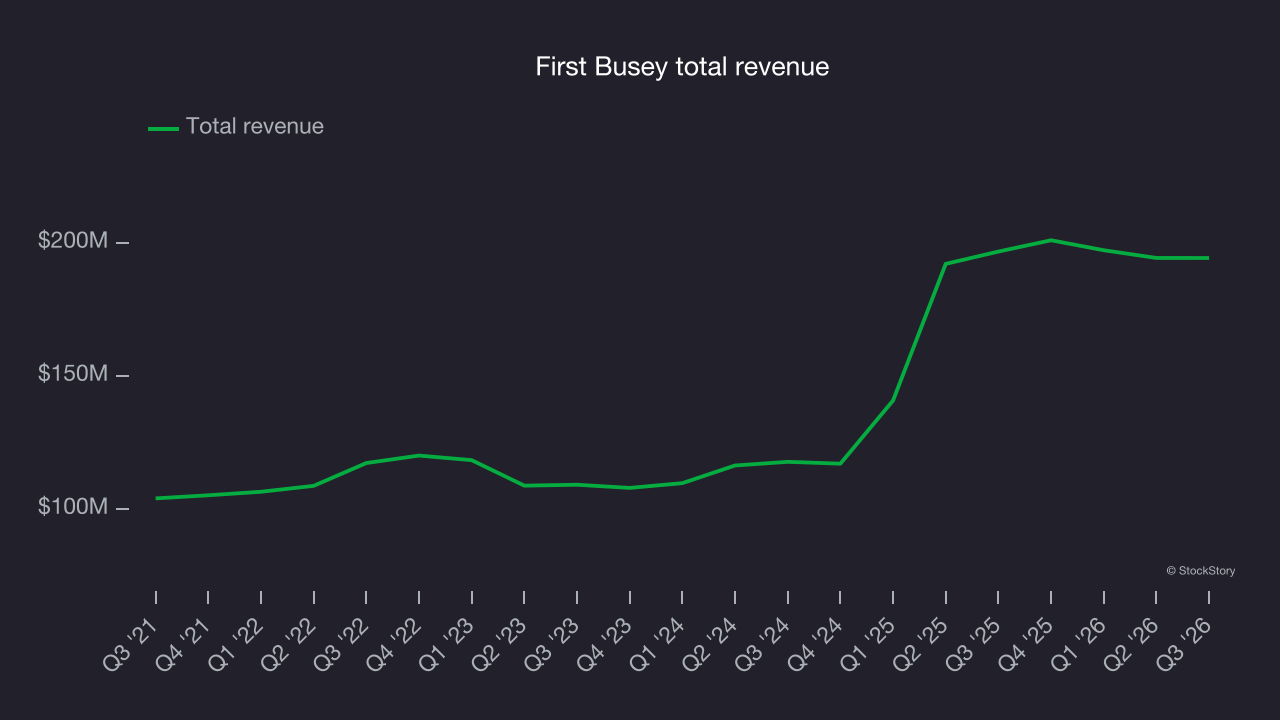
The market seems disappointed with the results as the stock is down 2.3% since reporting and currently trades at $29.49.
Read our full report on First Busey here, it’s free.
Best Q3: Merchants Bancorp (NASDAQ: MBIN)
With a strategic focus on low-risk, government-backed lending programs, Merchants Bancorp (NASDAQCM:MBIN) is an Indiana-based bank holding company specializing in multi-family mortgage banking, mortgage warehousing, and traditional banking services.
Merchants Bancorp reported revenues of $224.9 million, up 31.5% year on year, outperforming analysts’ expectations by 22.3%. The business had a very strong quarter with a beat of analysts’ EPS estimates and a narrow beat of analysts’ tangible book value per share estimates.
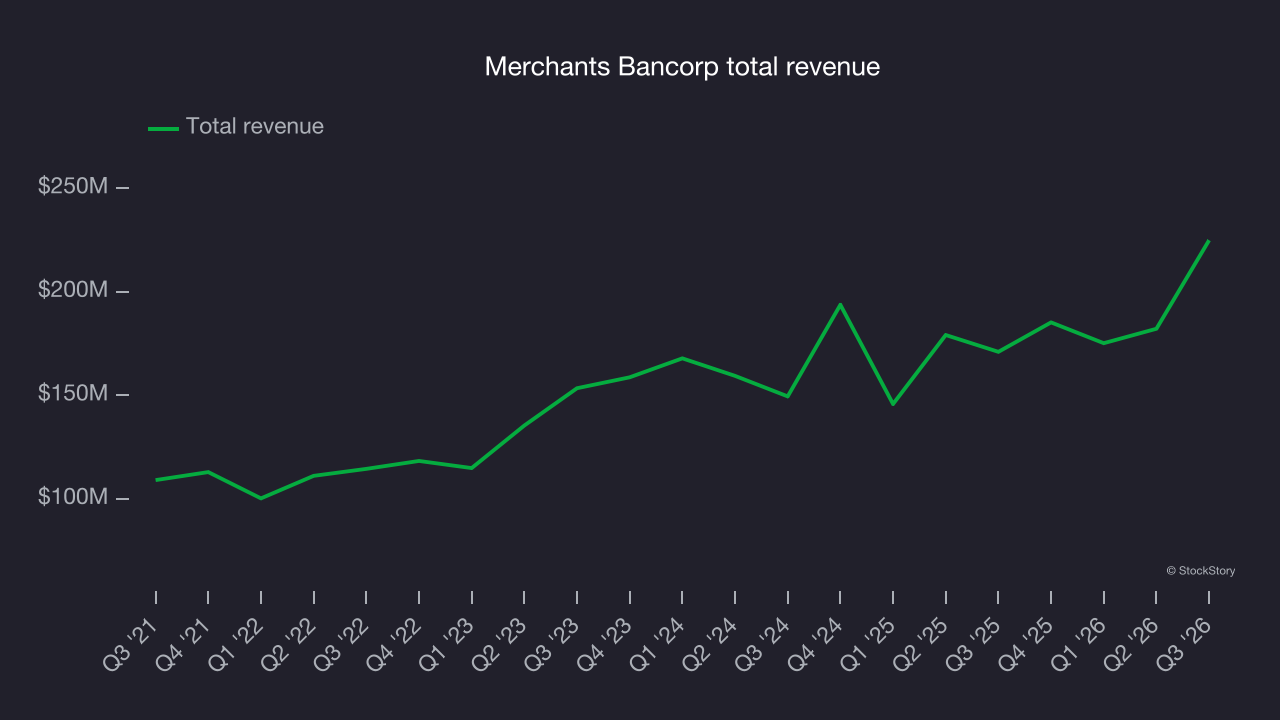
Merchants Bancorp scored the biggest analyst estimate beat in the group. The market seems happy with the results as the stock is up 6.1% since reporting. It currently trades at $52.15.
Is now the time to buy Merchants Bancorp? Access our full analysis of the earnings results here, it’s free.
Weakest Q3: National Bank Holdings (NYSE: NBHC)
Operating under familiar local brands like Community Banks of Colorado, Bank Midwest, and Bank of Jackson Hole, National Bank Holdings (NYSE: NBHC) operates regional banks across Colorado, Kansas, Missouri, Wyoming, Texas, and other western states, offering commercial, business, and consumer banking services.
National Bank Holdings reported revenues of $128.5 million, up 21.8% year on year, falling short of analysts’ expectations by 2.1%. It was a disappointing quarter as it posted a significant miss of analysts’ net interest income estimates and a significant miss of analysts’ EPS estimates.
As expected, the stock is down 4.4% since the results and currently trades at $37.25.
Read our full analysis of National Bank Holdings’s results here.
The Bancorp (NASDAQ: TBBK)
Operating behind the scenes of many popular fintech apps and prepaid cards you might use daily, The Bancorp (NASDAQ: TBBK) is a bank holding company that specializes in providing banking services to fintech companies and offering specialty lending products.
The Bancorp reported revenues of $175.9 million, flat year on year. This result came in 1.4% below analysts’ expectations. Overall, it was a softer quarter as it also recorded a significant miss of analysts’ tangible book value per share estimates and EPS in line with analysts’ estimates.
The stock is down 5.5% since reporting and currently trades at $47.72.
Read our full, actionable report on The Bancorp here, it’s free.
QCR Holdings (NASDAQ: QCRH)
With roots dating back to 1993 and a name reflecting its original Quad Cities market, QCR Holdings (NASDAQGM:QCRH) operates four community banks across Iowa and Missouri, providing commercial, consumer banking, and trust services to businesses and individuals.
QCR Holdings reported revenues of $109 million, down 2.9% year on year. This print was in line with analysts’ expectations. Taking a step back, it was a slower quarter as it logged a miss of analysts’ net interest income estimates and a miss of analysts’ tangible book value per share estimates.
The stock is up 1.6% since reporting and currently trades at $101.01.
Read our full, actionable report on QCR Holdings here, it’s free.
Market update
Over the past year, investors have been forced to repeatedly answer the same question: what is the market’s biggest risk? The answer has changed several times, and each shift has reshaped market leadership.
Late in 2025 and early 2026, artificial intelligence became the market’s primary uncertainty. Investors questioned whether AI would erode software pricing power and weaken competitive moats as AI made it easier to replicate once-differentiated products.
By the spring, technology took a back seat to geopolitics. The U.S. conflict with Iran briefly became the market’s dominant narrative, raising concerns about oil prices, inflation, and global growth. But as energy markets remained orderly and fears of a prolonged supply disruption faded, investors quickly turned their focus back to fundamentals.
Want to invest in winners with rock-solid fundamentals? Check out our 9 Best Market-Beating Stocks and add them to your watchlist. These companies are poised for growth regardless of the political or macroeconomic climate.