Waste and recycling services provider Quest Resource (NASDAQ: QRHC) missed Wall Street’s revenue expectations in Q3 2026, with revenue flat year on year at $63.78 million. Its GAAP loss of $0.02 per share was $0.02 above analysts’ consensus estimates.
For more on Quest Resource, read our free full research report.
Quest Resource (QRHC) Q3 2026 highlights:
- Revenue $63.78 million vs analysts’ consensus estimates of $66.3 million, according to S&P (flat year on year, 3.8% miss)
- EPS (GAAP) -$0.02 vs analysts’ consensus estimates of -$0.04 ($0.02 beat)
- Adjusted EBITDA $3.43 million vs analysts’ consensus estimates of $3.15 million (5.4% margin, relatively in line)
- Operating margin 2.7%, up from 1.5% in the same quarter last year
- Market capitalization $22.25 million
“Our third quarter results reflect the progress we are making in building a more balanced and diversified business, as consistent performance across our broader portfolio and continued operating efficiencies drove Adjusted EBITDA growth both sequentially and compared to the prior year period,” said Perry W. Moss, Quest's Chief Executive Officer. “We continue to expand share of wallet with existing customers, and we are encouraged by the quality of opportunities in our sales pipeline, including several large national brands. Having made significant progress building a more efficient operating foundation, we are now investing in our team and capabilities to capture these opportunities. We believe the growing diversification of our customer portfolio across market verticals mitigates sector-specific risk and supports our long-term growth.”
Revenue growth
Examining a company’s long-term performance can provide clues about its quality. Any business can report a good quarter or two, but the best consistently grow over the long term. Over the last five years, Quest Resource grew its revenue at a strong 12.6% compounded annual growth rate. Its growth beat the average industrials company and shows its offerings resonate with customers.
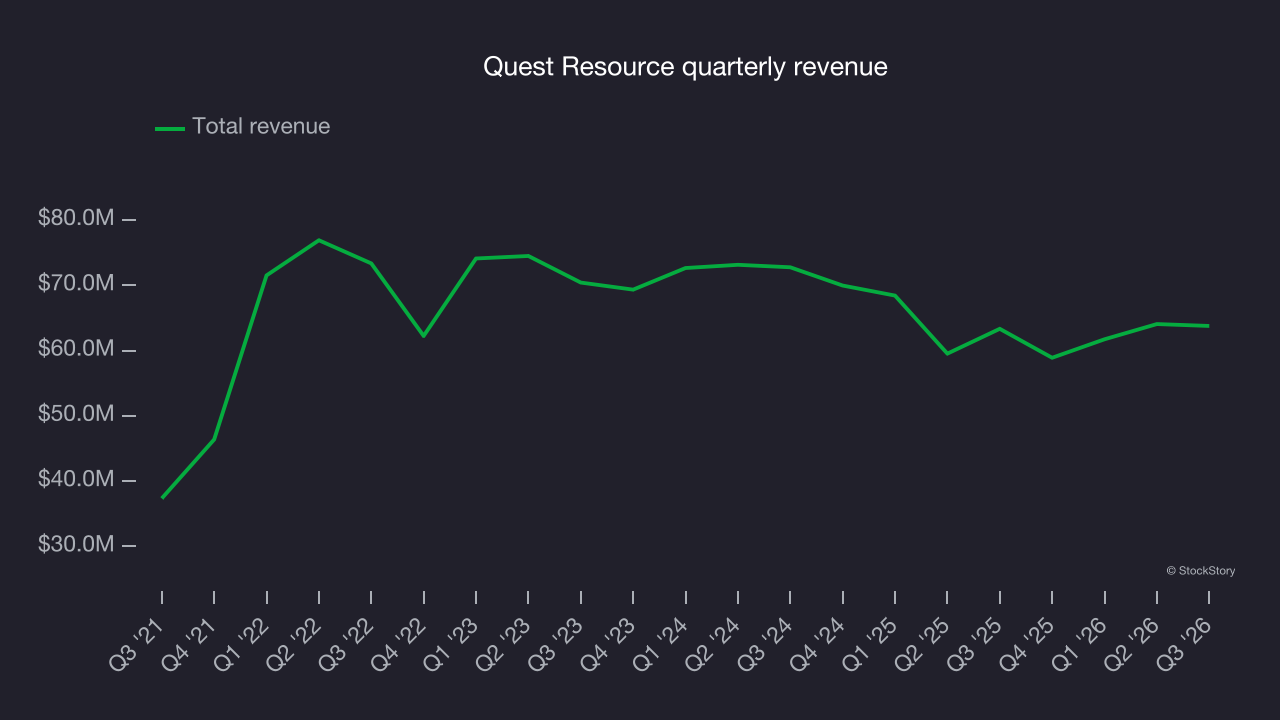
Long-term growth matters most, but within industrials, a half-decade historical view may miss cycles, industry trends or a company capitalizing on catalysts such as a new contract win or a successful product line. Quest Resource’s recent performance marks a sharp pivot from its five-year trend as its revenue has shown annualized declines of 7.1% over the last two years. 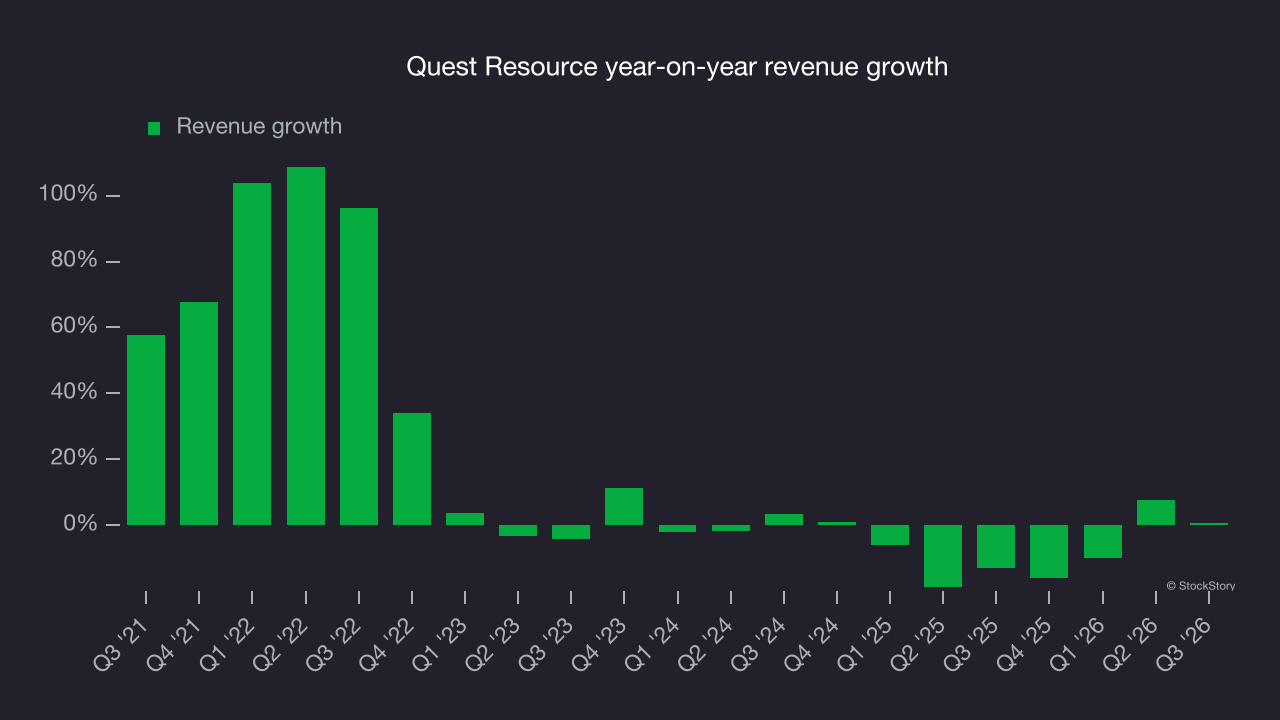
This quarter, Quest Resource’s $63.78 million of revenue was flat year on year, falling short of Wall Street’s consensus estimates.
Looking ahead, sell-side analysts expect revenue to grow 7.5% over the next 12 months, according to S&P, an improvement versus the last two years. This projection is above the sector average and suggests its newer products and services will spur better top-line performance.
Operating margin
Quest Resource’s operating margin has been trending up over the last 12 months, leading to breakeven profits over the last five years. However, its large expense base and inefficient cost structure mean it still has inadequate profitability for an industrials business. That outcome is unsurprising given its low gross margin baseline.
Looking at the trend in its profitability, Quest Resource’s operating margin might have fluctuated slightly but has generally stayed the same over the last five years. This raises questions about the company’s expense base because its revenue growth should have given it leverage on its fixed costs, resulting in better economies of scale and profitability.
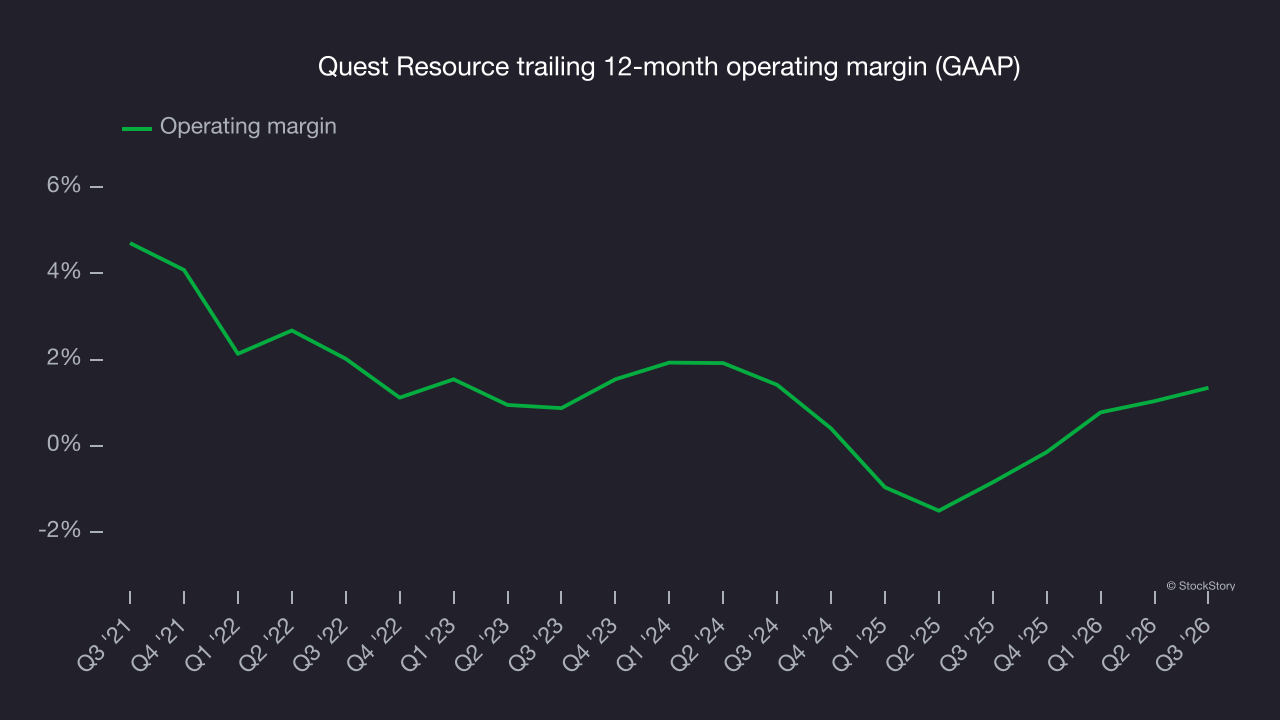
This quarter, Quest Resource generated an operating profit margin of 2.7%, up 1.2 percentage points year on year. The increase was encouraging, and the larger gain relative to gross margin indicated greater efficiency in expenses such as marketing, research and development and administrative overhead.
Earnings per share
Revenue trends explain a company’s historical growth, but the long-term change in earnings per share (EPS) points to the profitability of that growth. For example, a company could inflate its revenue through excessive spending on advertising and promotions.
Quest Resource’s EPS declined by 53.4% annually over the last five years while its revenue grew by 12.6%. However, its operating margin didn’t change during this time, indicating that non-fundamental factors such as interest and taxes affected its ultimate earnings.
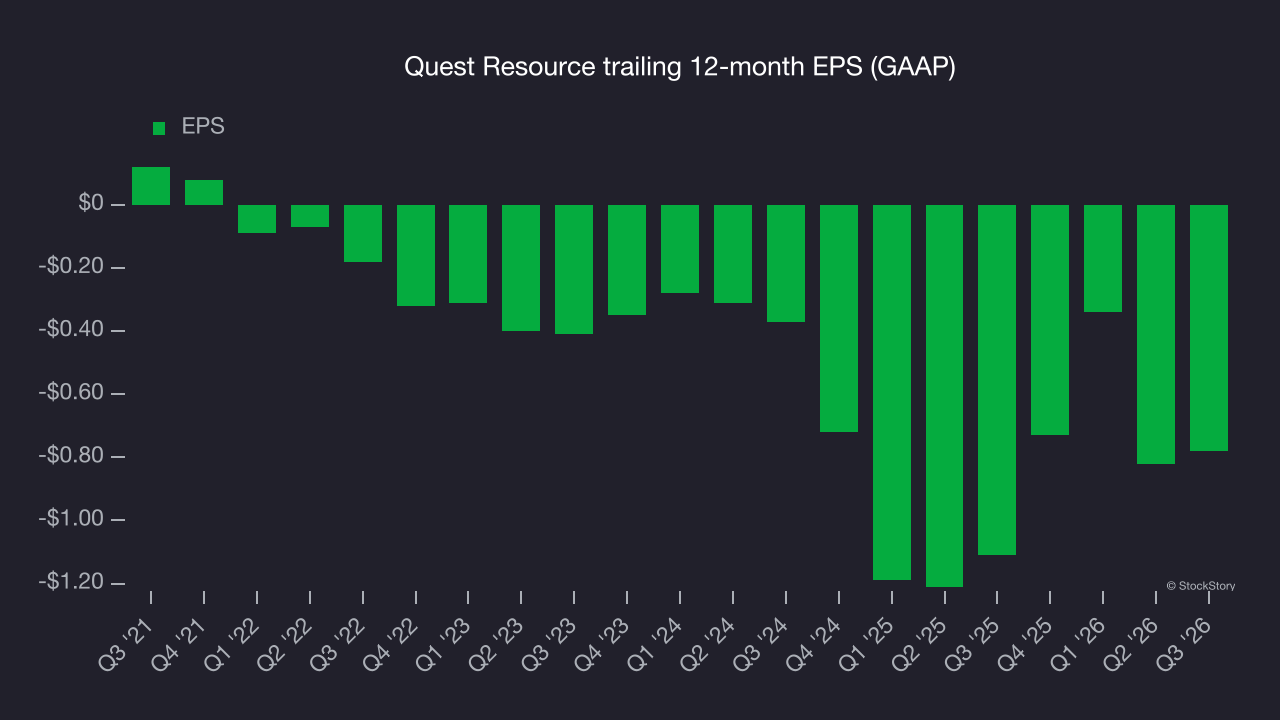
As with revenue, examining EPS over a more recent period can provide insight into an emerging theme or development for the business.
For Quest Resource, its two-year annual EPS declines of 45.2% show it’s still underperforming. These results were poor regardless of the period examined.
In Q3, Quest Resource reported EPS of negative $0.02, up from negative $0.06 in the same quarter last year. EPS came in well above analysts’ consensus estimates, a positive result for shareholders. Over the next 12 months, Wall Street expects Quest Resource to narrow its losses. Analysts forecast its full-year EPS will improve from negative $0.78 to negative $0.11, according to S&P.
Key takeaways from Quest Resource’s Q3 results
Quest Resource’s earnings were the highlight of a solid Q3: EPS beat analysts’ consensus estimates, and EBITDA topped Wall Street’s consensus by a wide margin. Revenue, however, missed expectations. The quarter still had clear positives, and shares remained flat at $1.04 immediately after the results.
For more on Quest Resource at its current price, the latest quarter is only one part of its longer-term business quality. Quality, combined with valuation, can help determine whether the stock is a buy. Read the full research report here (it’s free).