Online grocery delivery platform Instacart (NASDAQ: CART) announced better-than-expected revenue in Q3 2026, with revenue up 16.6% year on year to $1.10 billion. Its non-GAAP profit of $1.03 per share was 3.7% below analysts’ consensus estimates.
For more on Instacart, read our free full research report.
Instacart (CART) Q3 2026 highlights:
- Instacart enters into definitive agreement to be acquired by DoorDash in a cash-and-stock transaction with an equity value of approximately $17 billion; DoorDash will pay $65 per Instacart share, a 26% premium over the stock's Oct. 22 closing price
- Revenue $1.10 billion vs S&P analysts’ consensus estimates of $1.07 billion (16.6% year-on-year growth, 2.1% beat)
- Adjusted EPS $1.03 vs S&P analysts’ consensus estimates of $1.07 (3.7% miss)
- Adjusted EBITDA $342 million vs analysts’ consensus estimates of $332.7 million (31.2% margin, 2.8% beat)
- Operating margin 15.9%, down from 17.7% in the same quarter last year
- Free cash flow margin 28%, down from 46% in the previous quarter
- Market capitalization $13.52 billion
"Q3 was our best quarter as a public company, with GTV up 15% year-over-year and advertising and other revenue up 23% year-over-year. Our fundamentals keep getting stronger, with solid consumer demand, deepening customer engagement, and expanding profitability," said Chris Rogers, CEO. "Online grocery is still an underpenetrated category, and we're in the early stages of realizing what our purpose-built grocery technology can do to transform it. That's why we're building the operating system for grocery: one integrated platform that powers ecommerce, fulfillment, in-store, retail media, and AI Solutions. We're excited about what's ahead, working closely with our partners to strengthen and grow their businesses and shape the future of the grocery industry."
Revenue growth
A company’s long-term revenue performance is one signal of its overall quality. Any business can report a good quarter or two, but the best consistently grow over the long term. Over the last three years, Instacart grew its revenue at a decent 11.5% compounded annual growth rate. Its growth was slightly above the average consumer internet company and shows its offerings resonate with customers.
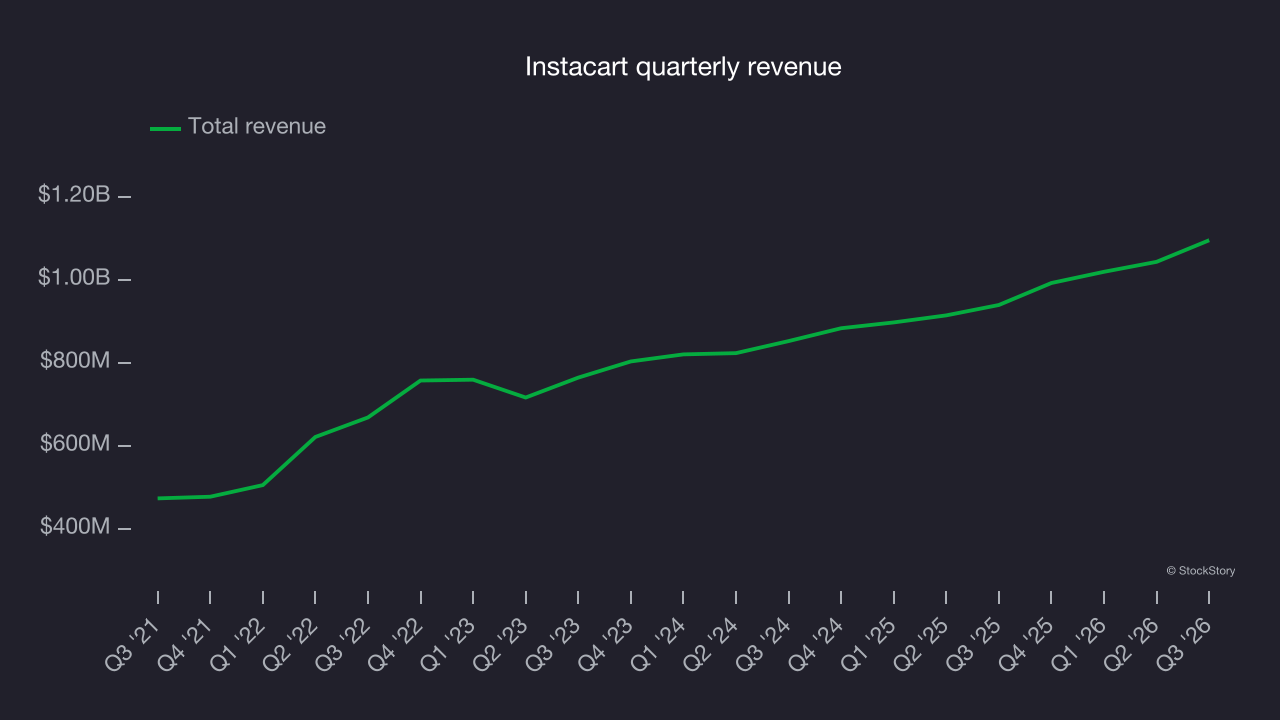
This quarter, Instacart reported year-on-year revenue growth of 16.6%, and its $1.10 billion of revenue exceeded Wall Street’s estimates by 2.1%.
Looking ahead, sell-side analysts expect revenue to grow 11.6% over the next 12 months, according to S&P, similar to its three-year rate. This projection is above average for the sector and implies its newer products and services will help support its historical top-line performance.
Free cash flow
Free cash flow matters because accounting profits alone can’t pay the bills.
Instacart has shown strong cash profitability, driven by its lucrative business model and cost-effective customer acquisition strategy that enable it to stay ahead of the competition through investments in new products rather than sales and marketing. The company’s free cash flow margin was among the best in the consumer internet sector, averaging 26.9% over the last two years.
On the positive side, Instacart’s margin expanded by 17.1 percentage points over the last few years. It became a less capital-intensive business, as its free cash flow profitability rose more than its operating profitability.
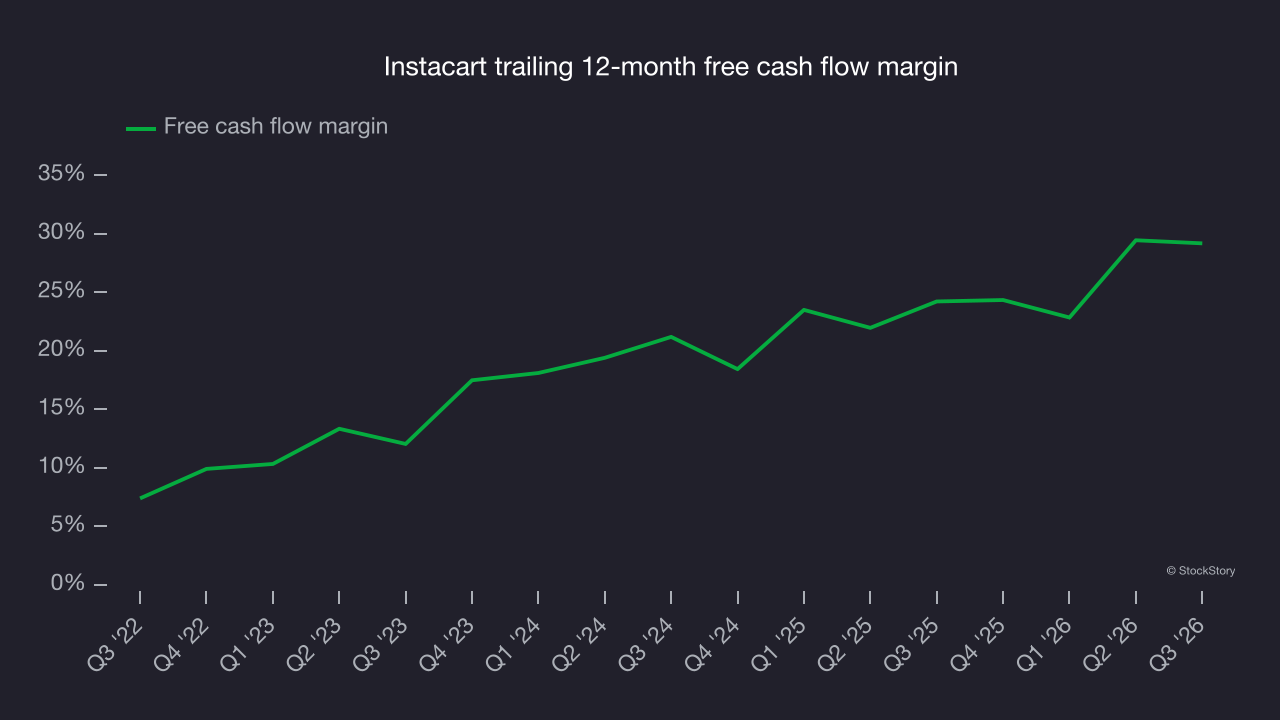
Instacart’s free cash flow was $307 million in Q3, equivalent to a 28% margin. This cash profitability was in line with the comparable period last year and above its two-year average.
Key takeaways from Instacart’s Q3 results
Instacart delivered some key positives in Q3, with both EBITDA and revenue topping analysts’ consensus estimates. Shares remained flat at $57.20 immediately after the results.
The latest quarter matters when deciding whether to buy the stock, but longer-term fundamentals and valuation matter much more. For more on those factors, read our full research report here (it’s free).