The face of retail has changed in recent years. Store managers handle understaffing, supply-chain delays, and a culture of embedded, organized, and opportunistic theft that has motivated most chains to adjust store hours, shut down shop locations, or reduce merchandise items on shelves.
To retaliate against this, more US retailers are increasingly considering radiofrequency identification not as a one-size-fits-all silver bullet but as a layer of a data-driven defense.
This editorial looks at the RFID retail implementations of slowing shoplifting, restoring inventory integrity, and providing stores with practical operational control over loses.
The Scale Of The Problem
Shrink in retail is still a very grave business issue. The recent security surveys conducted by the National Retail Federation, compared to lists of the previous three years, showed that shrink, which was predominantly caused by outside thefts, cost the industry hundreds of billions of dollars, with a significant increase in 2019.
Data released by the NRF indicates more incidents, dollar losses correspond to the shoplifting and organized retail crime, which impact the strategy and profit margin of the retailer.
What RFID Brings To Loss Prevention (And What It Does Not)
RFID tags are small, cheap electronic tags that are attached to things (or their packages). RFID does not need line of sight, as did barcodes: a reader is able to read many tags simultaneously and item-level tracking in nearly real time. That ability will provide that the stores have something they have always been missing, which is the actual continuous visibility of the location of merchandise.
Importantly, RFID cannot substitute security guards, CCTV, or legal enforcement. Instead, it is a visibility tool which:
– Exposes item non-locations or loss;
– Ties motion in certain areas and time addresses (that can be associated with camera tracks); and
– Allows read exit-portals and automated alarms as tagged items surpass thresholds without having a point-of-sale occurrence.
Concisely, RFID solutions enhance attribution, situational awareness, exposing other loss-prevention strategies to be significantly more effective.
Use Cases: How US Chains Deploy RFID To Fight Theft
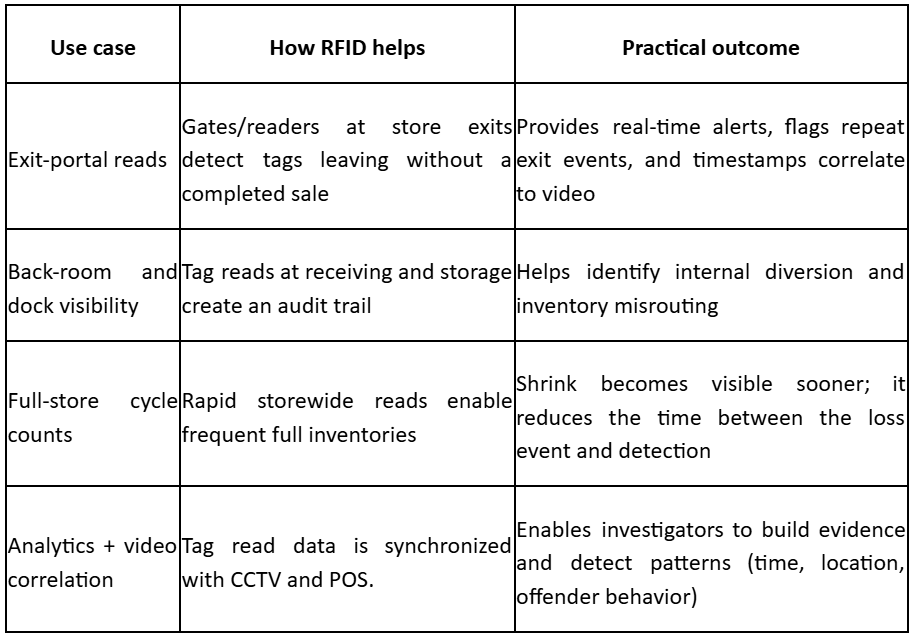
Table 1.1 Deployment of RFID in US Chains
Real Examples From US Retailers
In the US, shoplifting has turned into an epidemic where the breakage of glasses of store glass and the use of arms to lift items are becoming common. The shrinkage cost for the companies is getting higher, and that leads to additional costs in each store.
– Macy’s: Inventory visibility used to surface loss events
One of the best-documented cases in the US is Macy. The chain embarked on widespread RFID tagging to accommodate omnichannel guarantees – buy anywhere, fulfill anywhere – but soon discovered a secondary advantage: a more detailed loss-prevention data set.
Store-level tag analytics and exit reads enabled Macy’s to identify suspected movement anomalous to conduct the investigation faster and use video to match the data to lessen unresolved losses. Inventory accuracy by retailer improved significantly after the RFID was rolled out, which correspondingly lowered the mystery shrinkage and the sell-through of key SKUs.
– American Apparel: Measurable shrink reduction after RFID
The implementation of item-level RFID at American Apparel became a test case for the visibility-decreasing shrink. Following the installation of item-level tagging detection and an extensive read environment, the retailer said that sales involved recovery of inventory doubled, and publicly credited significant shrink both internal and external to RFID-facilitated responsibility. American Apparel is mentioned in the academic and industry reports as experiencing more than a 50% reduction in shrink in implementation.
– Zara/Inditex: Fast replenishment AND better loss intelligence
To accelerate replenishment and enhance the tracing capability of items, Inditex (parent company of Zara) applies RFID on a very large scale. Though the brand focuses on responsiveness and speed, the same tag information feed provides merchants with a better understanding of item traffic and possible instances of losses, which is extremely important in high-density urban areas where shoplifting and organized crime can reach their peak. Inditex is finding RFID-related operational efficiencies that indirectly minimize the possibility of theft by reducing the time items spend in the sales store or transit.
Evidence That RFID Changes The Loss Equation
RFID is valuable in loss prevention in three ways, which can be seen:
– More frequent, nearly instant inventories. Faster detection: Since inventories are conducted frequently and often almost immediately, the time within which something can be stolen without detection is shortened.
– Greater proof of event sequence Tag reads have timestamps and location metadata, which can be matched to video and aid in making the investigation more productive, and require fewer repeat events.
– Operation closure – Staff can find an item within a few minutes there is minimal shrink due to the misplaced inventory that is wrongly registered as lost or stolen.
An analysis of 2024 by industry outlets also reveals how retailers who had well-developed RFID deployments developed new insights into daily instances of loss and were better able to remediate. The points that these studies made support the idea that RFID is an enabler: it makes human investigators and technological deterrents more effective.
When RFID Is Most Effective: Lessons Learned
As retailers and loss-prevention teams that experience any tangible improvement tend to have in common, several attributes tend to appear:
– Item-level Tagging: Item tags are granular enough to detect individual theft cases.
– Integrated Systems: RFID readers, POS, CCTV, and analytics are integrated. RFID readers should be linked with the other devices to provide prompt responses.
– Analytics and workflows: Data minus processes is noise; there should be rules in stores that transform reads into actions (video scrutiny, associate checks, police reports).
– Risk points in terms of exit portals: the most valuable alerts are provided by high-throughput doorways and stockroom exits.
The side of security spending should also be accompanied by training and legal measures; RFID amplifies the observation, but human and institutional reactions should be made.
A Brief Caution: Privacy And Customer Experience
RFID loss prevention raises consumer, legal, and labor issues. The best practice within the context of US retail is: (1) not to label identifiable person-related data using tags; (2) emphasize the movement of goods and store areas, but not people; and (3) transparent data-retention and data-use policies, transparency to partners and auditors.
When RFID is used properly, it can improve the shopping experience because the inventory would be kept accurate without intruding into the store, as in the case of hip-hop surveillance.
Bottom Line: RFID As A Strategic Component Of Loss Reduction
The shopping mall theft epidemic is multi-layered – based on social, legal, and criminal mechanics, although this should not imply that shopkeepers are passive. RFID solutions provide chains with a means to control information again. RFID retail implementations allow cutting down the lag between an incident and a useful response by either allowing real-time physical store counts or by tagging products as they pass through the backrooms, or by aligning RFID reads with video evidence.
All of those numbers are imaginary: industry reports and recorded retailer case studies, whether it is Macy’s or American Apparel, or Inditex, indicate that visibility does deliver. That would not only affect the store’s profitability, but it would also mean that some locations are not even viable anymore, given the amounts of loss that the NRF and other analysts are saying they have had.