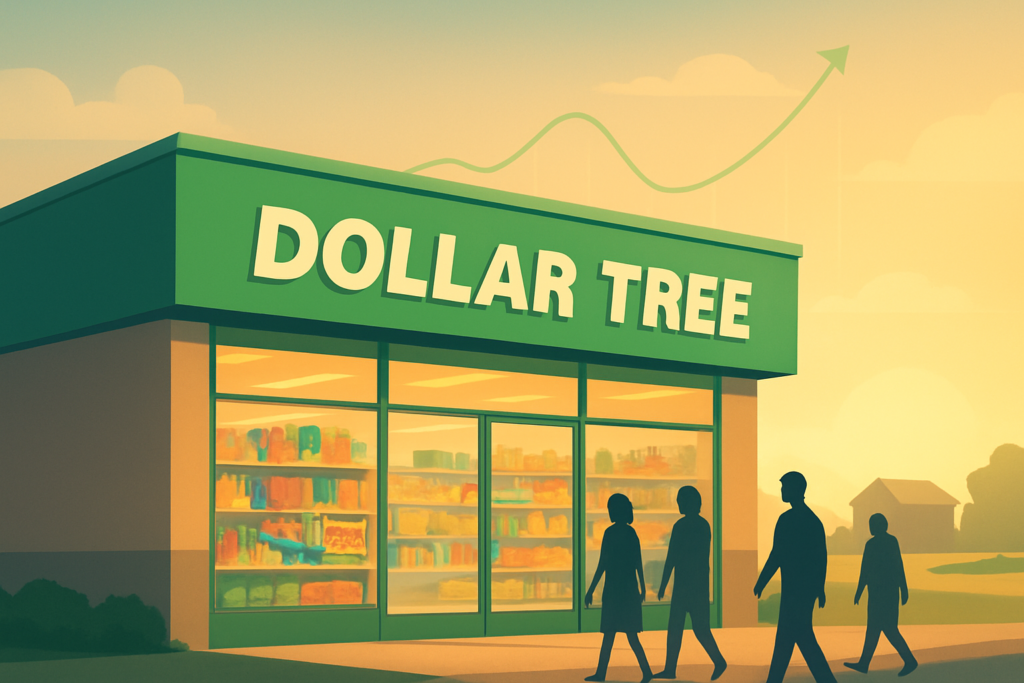
As of December 26, 2025, the retail landscape has witnessed one of the most significant corporate transformations in recent memory: the rebirth of Dollar Tree, Inc. (NASDAQ: DLTR) as a streamlined, "pure-play" entity. After years of struggling to integrate its 2015 acquisition of Family Dollar, the company spent 2025 shedding its underperforming weight and leaning into a new, multi-price identity. This research feature examines the narrative, financial health, and future trajectory of a retail giant that has successfully navigated a "Phoenix Rising" moment.
Introduction
Dollar Tree, Inc. (NASDAQ: DLTR) enters the final days of 2025 as a company fundamentally different from its former self. Long defined by its rigid $1.00 (and later $1.25) price point and its troubled ownership of the Family Dollar banner, the company has spent the last 18 months executing a radical pivot. By mid-2025, Dollar Tree completed the divestiture of Family Dollar, effectively ending a decade-long saga that many analysts viewed as a drag on shareholder value. Today, the focus is squarely on the core "Dollar Tree" brand and its "Dollar Tree 3.0" initiative—a multi-price strategy that has expanded the store’s offerings from $1.25 to as high as $7.00. With a new leadership team and a leaner corporate structure, DLTR is currently one of the most watched turnaround stories in the consumer discretionary sector.
Historical Background
The Dollar Tree story began in 1986, when founders Macon Brock, Doug Perry, and Ray Compton rebranded their "Only $1.00" concept stores in Norfolk, Virginia. Originally a side venture of the K&K Toys chain, the brand quickly gained a cult following for its simple value proposition: everything in the store cost exactly one dollar. The company went public on the NASDAQ in 1995 and spent the next two decades in a period of aggressive expansion, acquiring competitors like Dollar Express and It's A Dollar.
The most defining moment in the company’s history occurred in 2015, when it won a bidding war against Dollar General (NYSE: DG) to acquire Family Dollar for $8.5 billion. While the move was intended to diversify the customer base and footprint, the integration proved disastrous. Family Dollar struggled with dilapidated stores, operational inefficiencies, and a consumer demographic that differed significantly from the "treasure hunt" shoppers of Dollar Tree. It was not until the activist intervention of Elliott Management and the subsequent strategic review in 2024 that the company finally moved toward the 2025 sale that has defined its current era.
Business Model
Dollar Tree’s business model has evolved from a fixed-price discounter to a sophisticated multi-price value retailer. The core segments now include:
- Consumables: High-frequency items such as food, beverages, and health/beauty products. The expansion of chilled and frozen sections has been a major driver of foot traffic.
- Variety/General Merchandise: Seasonal decor, party supplies, toys, and stationery. This segment remains the company's highest-margin category, benefiting from the "treasure hunt" psychology.
- The Multi-Price Strategy (Dollar Tree 3.0): Unlike the old model where everything was one price, the new model mixes $1.25, $1.50, $2.00, $3.00, $5.00, and $7.00 items. This allows the company to carry higher-quality goods and maintain margins despite inflationary pressures.
The customer base has also shifted. While historically serving low-income households, the "trade-down" effect of 2024-2025 has brought an influx of middle-income shoppers seeking to stretch their budgets for household essentials and seasonal celebrations.
Stock Performance Overview
The performance of DLTR stock over the last decade has been a tale of two halves.
- 10-Year Horizon: The stock spent much of 2015–2022 range-bound, weighed down by the "Family Dollar anchor."
- 5-Year Horizon: Performance was highly volatile, peaking during the 2022 inflation surge but crashing in 2024 as the company took multi-billion dollar write-downs on its Family Dollar assets.
- 1-Year Horizon (2025): This has been a year of recovery. After bottoming out near $65 in late 2024, the stock rallied approximately 60% through 2025, trading at $122.01 as of late December. The completion of the Family Dollar sale in July 2025 served as the primary catalyst for this re-rating, as investors cheered the simplified balance sheet and improved margin profile.
Financial Performance
Dollar Tree’s financial health in 2025 reflects a company in the middle of a high-stakes cleanup.
- Fiscal 2024 Recap: The company reported a net loss of $1.71 billion, largely due to a non-cash goodwill impairment charge of $950 million related to the Family Dollar segment and the costs of closing nearly 1,000 stores.
- 2025 Growth: The turnaround is evident in the Q3 2025 results. Net sales reached $4.75 billion, a 9.4% year-over-year increase. More importantly, same-store sales grew by 4.2%.
- Margins and Guidance: With the higher-margin multi-price goods now making up a larger portion of the basket, gross margins have improved to approximately 31.5%. Full-year 2025 guidance was recently raised to an adjusted EPS range of $5.60 to $5.80, signaling strong confidence in the core brand’s holiday performance.
Leadership and Management
The leadership transition of late 2024 and 2025 has been pivotal. Following the retirement of retail veteran Rick Dreiling due to health reasons, Michael C. Creedon, Jr. was named CEO in December 2024. Creedon, who previously served as COO, has been the primary architect of the "pure-play" transition.
The management team has earned praise from the board for its "maniacal focus" on store-level execution. The 2025 strategy has revolved around three pillars: price-point expansion, supply chain modernization, and digital loyalty. The board’s governance reputation has improved significantly since the 2022 overhaul, showing a newfound willingness to make difficult divestiture decisions to protect long-term shareholder interest.
Products, Services, and Innovations
Innovation at Dollar Tree is no longer about finding a way to sell a product for a dollar; it is about "value engineering."
- Chilled and Frozen Expansion: The company has aggressively expanded its freezer sections to include name-brand frozen dinners, proteins, and dairy, often at the $3.00 to $5.00 price points.
- Private Label: Dollar Tree has expanded its private-label portfolio, offering premium-quality household goods that provide higher margins than national brands.
- Digital Transformation: 2025 saw the full-scale launch of the "Dollar Tree Rewards" program, using data analytics to offer personalized digital coupons—a first for the historically "analog" retailer.
Competitive Landscape
Dollar Tree operates in a hyper-competitive value sector:
- Dollar General (NYSE: DG): The primary rival, DG dominates the rural market. However, Dollar Tree’s suburban and urban focus provides a demographic buffer.
- Five Below (NASDAQ: FIVE): Competes for the teen and "trend" shopper. Dollar Tree’s expansion into the $5+ range puts it in more direct competition with FIVE’s "extreme value" model.
- Walmart (NYSE: WMT): The scale leader. While Walmart wins on sheer volume, Dollar Tree wins on convenience and the "low out-of-pocket" price point for individual items.
- E-commerce (Temu/Shein): These platforms have challenged the general merchandise and toy categories, though Dollar Tree’s strength in consumables provides a defensive moat.
Industry and Market Trends
The "Value Sector Bifurcation" is the dominant trend of 2025. While higher-end retailers have struggled with cooling consumer spending, value retailers have benefited from the "trade-down" effect. Middle-income households (earning $75k–$100k) are increasingly shopping at Dollar Tree for pantry staples. Additionally, the labor market remains tight in the retail sector, forcing the company to invest in automated checkout and warehouse robotics to maintain operational efficiency.
Risks and Challenges
Despite the positive momentum, DLTR faces significant headwinds:
- Inventory Shrink: Retail theft remains a persistent drain on margins. While management has implemented more locked displays and AI-monitored self-checkout, "shrink" continues to offset some of the gains from the multi-price rollout.
- Import Reliance: With a large percentage of its general merchandise sourced from overseas, the company is highly sensitive to geopolitical tensions and freight costs.
- The "Dollar Store Stigma": Long-standing issues with store cleanliness and staffing remain a challenge for the brand’s reputation as it tries to attract higher-income shoppers.
Opportunities and Catalysts
- Family Dollar Exit Upside: The sale to Brigade/Macellum for $1.01 billion in cash allows Dollar Tree to pay down debt and reinvest in the core brand’s infrastructure.
- Store Renovation Cycle: The "DT 3.0" renovations are currently only in a fraction of the fleet. Each converted store typically sees a double-digit lift in same-store sales.
- M&A and Expansion: Now that the company is leaner, there is speculation about potential acquisitions of regional players or a deeper push into the Canadian market.
Investor Sentiment and Analyst Coverage
Wall Street is currently "cautiously bullish" on DLTR.
- Consensus Rating: Moderate Buy.
- Price Targets: Analysts at Wells Fargo and Barclays have recently raised targets to the $136–$145 range, citing the "pure-play" valuation multiple.
- Institutional Activity: Major hedge funds that pushed for the Family Dollar sale have remained largely in the stock, waiting for the margin expansion from the multi-price rollout to fully hit the bottom line in FY2026.
Regulatory, Policy, and Geopolitical Factors
- Safety Compliance: In April 2025, Dollar Tree paid over $41 million in fines related to historic warehouse issues. The company remains under a strict OSHA settlement.
- Tariff Policies: With the 2026 trade outlook uncertain, any significant increase in tariffs on Chinese goods would directly impact the cost of goods sold.
- Minimum Wage: Advocacy for a higher federal minimum wage continues to be a legislative risk for a company with a large, low-wage workforce.
Conclusion
Dollar Tree’s performance in 2025 has been a masterclass in corporate "pruning." By severing the Family Dollar branch, the company has allowed its core brand to flourish under a more flexible, multi-price model. Investors should watch the 2026 margin reports closely; if the company can successfully manage the twin threats of inventory shrink and potential tariffs, its journey from a "dollar store" to a "multi-price value leader" could be the definitive retail success story of the decade.
This content is intended for informational purposes only and is not financial advice. All data and stock prices are reflective of 12/26/2025.