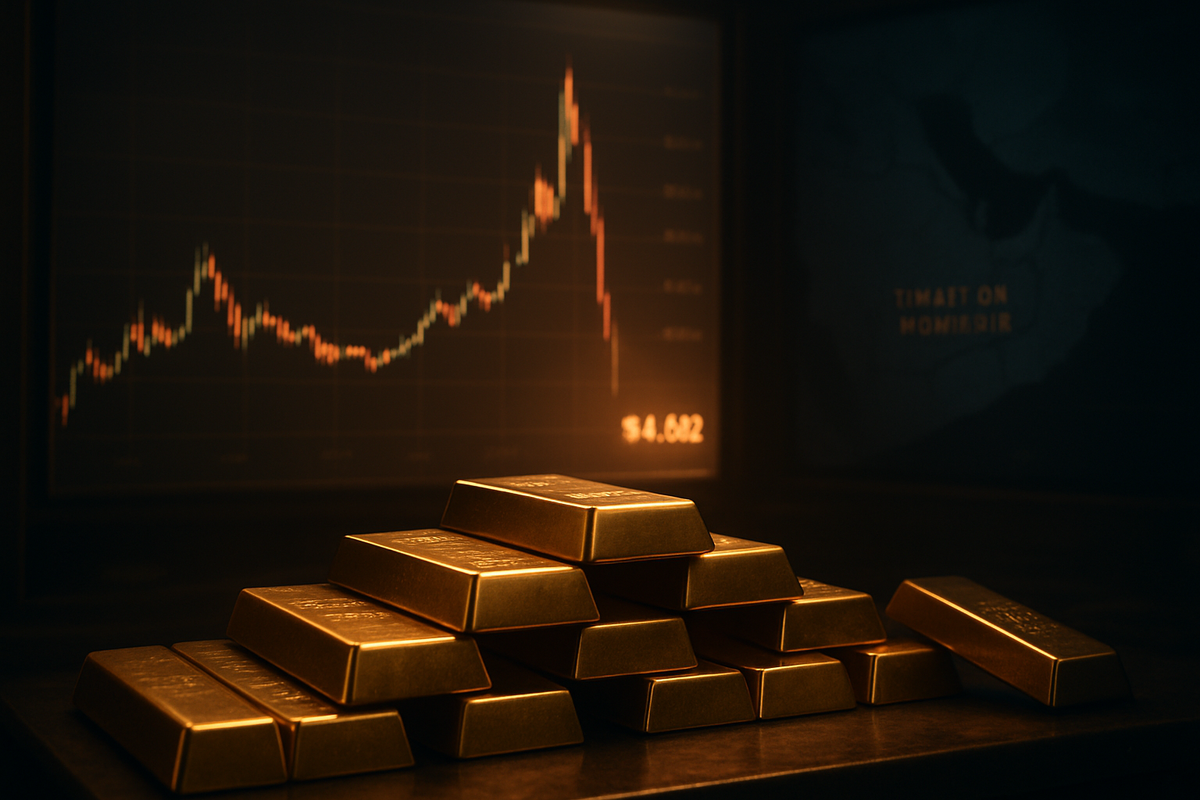
Gold prices have entered a period of uneasy stabilization, hovering around $4,682 per ounce on April 7, 2026, following a quarter of unprecedented market whiplash. The precious metal, which traditionally serves as the global financial system's ultimate insurance policy, has recently behaved more like a high-stakes poker chip, swinging from an all-time high of $5,500 in February to a gut-wrenching low of $4,100 just weeks ago. This volatility has been fueled by a paradoxical mix of record-breaking safe-haven demand and desperate institutional selling as the conflict in the Middle East reshapes global trade.
The current stabilization at $4,682 reflects a market caught between two opposing forces: the terrifying escalation of the "Iran War" and a massive liquidity crunch that has forced even central banks to dump their gold reserves. Investors are now holding their breath as a 20:00 EDT deadline approaches—an ultimatum set by the United States for the reopening of the Strait of Hormuz—which could either propel gold back toward the $5,500 peak or trigger another round of speculative liquidation if a diplomatic breakthrough is reached.
The Rollercoaster to $4,682: Speculation and the Turkish Sell-Off
The first quarter of 2026 will be remembered as the era of the "Liquidity Rupture." After gold breached the $5,000 barrier in January amid rising tensions with Tehran, a speculative frenzy drove prices to a parabolic peak of $5,500. However, the subsequent start of "Operation Epic Fury"—a joint military effort to secure regional oil lanes—had an unexpected effect on the markets. Instead of gold continuing its moonshot, a massive equity market crash triggered a "sell everything" moment. Institutional investors, faced with billions in margin calls on tech and energy stocks, were forced to liquidate their most profitable asset: gold.
Adding fuel to the downward spiral was a bombshell move by the Central Bank of the Republic of Turkey (CBRT). Reeling from the cost of energy imports and a plummeting Lira, the Turkish central bank reportedly sold off 60 tons of gold in a massive block to shore up its foreign exchange reserves. This unexpected flood of supply, combined with a hawkish shift in U.S. monetary policy under Federal Reserve Chair Kevin Warsh, sent the metal into a freefall, bottoming out at $4,100. It is only in the last 72 hours that safe-haven bidding has returned in earnest, as the threat of a full-scale regional war outweighs the immediate need for cash.
Winners and Losers: Miners Struggle While ETFs Bleed Cash
The extreme price swings have created a "Great Decoupling" within the gold sector. Newmont Corporation (NYSE: NEM), the world's largest gold miner, recently announced that 2026 would be a "trough year" as it grapples with All-In Sustaining Costs (AISC) that have ballooned to nearly $1,700 per ounce due to the soaring cost of diesel and logistics in a war-torn global economy. Similarly, Barrick Gold Corporation (NYSE: GOLD) has seen its shares dive nearly 25% from its yearly highs, as the liquidity crunch hit mining equities far harder than the physical bullion itself.
On the investment side, the SPDR Gold Shares (NYSE Arca: GLD) experienced its largest single-month outflow in history during the March crash, losing nearly $11 billion in assets under management as hedge funds tapped the fund for liquidity. While physical bullion holders are seeing their wealth preserved at these $4,600 levels, the VanEck Gold Miners ETF (NYSE Arca: GDX) remains down significantly on the year, reflecting investor fears that higher interest rates and operational costs will eat into the profits of miners even if gold prices stay elevated. Companies like Agnico Eagle Mines Limited (NYSE: AEM) have pivoted toward defensive capital preservation, cutting exploration budgets to weather the storm.
A New Global Paradigm: Gold as the Asset of Last Resort
The events of early 2026 have fundamentally changed the market's perception of gold's role in a modern crisis. Historically, gold was the first asset investors bought during a war. In 2026, it has become the last asset they sell. The $4,100 bottom proved that even "digital gold" and paper contracts are not immune to the gravity of a broader financial meltdown. This trend mirrors the early days of the 2008 financial crisis and the 2020 pandemic, where gold initially dropped as investors scrambled for U.S. Dollars before making a roaring recovery once the liquidity panic subsided.
Furthermore, the Turkish central bank's decision to dump 60 tons of gold signals a shift in central bank behavior. After years of record buying by the "Global South," the current energy crisis is forcing these nations to treat their gold reserves as a tactical currency stabilizer rather than a long-term store of value. This transition from central banks being "price-insensitive buyers" to "emergency sellers" creates a new ceiling for gold prices that did not exist in the early 2020s. Regulatory eyes are also on the Fed, as the "Sound Money" doctrine of the current administration has kept Treasury yields high, providing a stiff headwind for gold despite the geopolitical chaos.
The Path Ahead: The 8:00 PM Ultimatum and Market Scenarios
The immediate future of the gold market hinges entirely on the next 12 hours. If the 8:00 PM EDT deadline passes without a resolution to the Strait of Hormuz blockade, analysts expect a massive "fear bid" to return to the market, potentially re-testing the $5,000 level within days. In this scenario, gold will likely decouple from the dollar, rising alongside the DXY as investors flee both European and Asian currencies. The primary challenge will be the supply chain; with major shipping lanes closed, the physical delivery of gold from refineries in Switzerland to hubs in London and New York could face significant delays, leading to wider spreads between spot and futures prices.
Conversely, should a ceasefire or a diplomatic "de-escalation zone" be announced, the $4,682 floor may prove to be made of sand. A return to "normalcy" would likely trigger another round of profit-taking from the speculators who bought the $4,100 dip, potentially pushing the metal back toward the $4,300 range. Strategic pivots for mining companies like Kinross Gold Corporation (NYSE: KGC) will involve aggressive hedging strategies to lock in current prices, as the volatility of the last three months has made long-term budgeting nearly impossible.
Summary: Navigating a High-Stakes Gold Market
As we mark April 7, 2026, the gold market stands at a historic crossroads. The stabilization at $4,682 is a temporary equilibrium in a world defined by the "Iran Shock," central bank desperation, and a hawkish Federal Reserve. The key takeaway for investors is that while gold remains the ultimate safe haven, its path is no longer a straight line upward. The "liquidity piggy bank" effect means that in moments of extreme systemic stress, gold can and will be sold to cover losses elsewhere, creating buying opportunities for those with the stomach for $1,000 swings.
Moving forward, the market will be hyper-sensitive to any signs of further central bank selling or shifts in the Middle Eastern conflict. For now, the "gold standard" of the 2020s is defined by its extreme volatility rather than its traditional stability. Investors should keep a close eye on the 10-year Treasury yield and the daily headlines out of the Persian Gulf. In this high-stakes environment, the only certainty is that the quiet at $4,682 is unlikely to last through the week.
This content is intended for informational purposes only and is not financial advice.