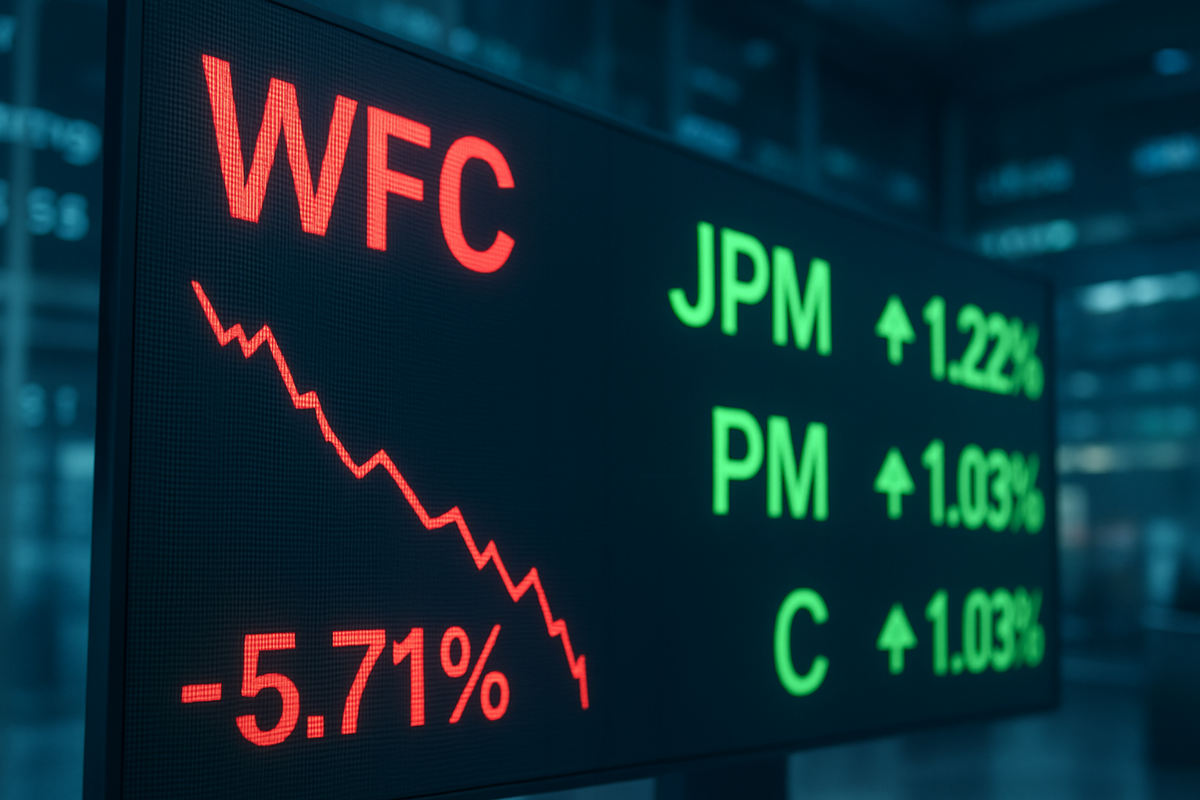
The 2026 spring earnings season for the banking sector began with a stark reminder of the operational challenges facing one of the nation's largest lenders. On Tuesday, April 14, 2026, shares of Wells Fargo & Co. (NYSE: WFC) plummeted 6.6%, as a disappointing revenue report and shrinking interest margins overshadowed a technical beat on earnings per share. The sell-off represents the bank's worst single-day performance in over a year, signaling that investors are losing patience with the slow pace of the bank’s post-regulatory recovery.
While Wells Fargo grappled with rising deposit costs and stagnant loan income, its primary competitors painted a far more optimistic picture. The divergence in performance highlights a "resilience rift" within the financial sector, where giants like JPMorgan Chase & Co. (NYSE: JPM) and Citigroup Inc. (NYSE: C) have managed to navigate a high-interest-rate environment with significantly more agility, leaving Wells Fargo to languish at the bottom of the big-bank leaderboard this week.
Operational Hurdles and Revenue Shortfalls
The primary catalyst for Tuesday’s slide was Wells Fargo’s first-quarter revenue, which came in at $21.45 billion, falling short of the $21.77 billion consensus estimate. While the bank reported an earnings per share (EPS) of $1.60—narrowly beating the $1.58 expected by analysts—the victory was hollowed out by a $135 million discrete tax benefit that inflated the bottom line. Stripping away such one-time items, the underlying operational performance suggested a bank still struggling to find its footing after years of regulatory oversight.
The most concerning metric for analysts was the Net Interest Margin (NIM), which compressed to 2.47%, missing the 2.60% target. Management pointed to a "deposit beta" problem—the necessity of paying higher interest rates to prevent customers from moving their cash into high-yield money market funds. This, combined with a Net Interest Income (NII) of $12.1 billion (missing the $12.3 billion forecast), indicated that the bank is not yet fully benefiting from its newfound freedom to grow its balance sheet.
A Tale of Two Tiers: Winners and Losers
The market’s harsh reaction to Wells Fargo was amplified by the strong results posted by its peers earlier in the week. Citigroup Inc. (NYSE: C) emerged as the week’s standout winner, with its stock rising 1.5% after reporting a massive EPS beat of $3.06 against expectations of $2.63. Under the leadership of Jane Fraser, Citi’s "Project Bora Bora" restructuring efforts appear to be bearing fruit, as the bank improved its efficiency ratio to 58%, far outpacing Wells Fargo’s deteriorating 67%.
JPMorgan Chase & Co. (NYSE: JPM) also reinforced its "fortress" reputation, delivering $50.50 billion in revenue and an EPS of $5.94, crushing estimates. Although JPMorgan’s management slightly lowered their full-year NII guidance, their ability to generate a 23% Return on Tangible Common Equity (ROTCE) kept investors confident, with the stock only seeing a marginal 0.9% dip in a broader market rotation. Meanwhile, Bank of America Corp. (NYSE: BAC) is set to report on April 15, and analysts expect the lender to maintain its 7% year-over-year NII growth, further isolating Wells Fargo as the sector's underperformer.
The Post-Asset Cap Reality
The narrative surrounding Wells Fargo has shifted significantly over the past year. In June 2025, the Federal Reserve finally lifted the $1.95 trillion asset cap that had shackled the bank since 2018. This was followed by the termination of a major 2018 consent order on March 5, 2026. For years, investors had blamed Wells Fargo’s underperformance on these regulatory "handcuffs." However, with the cap gone and the bank’s loan book topping $1 trillion for the first time in six years this quarter, the 6.6% drop suggests the market is now judging the bank solely on its ability to compete.
This event fits into a broader trend of "the cost of loyalty" in the banking industry. As the Federal Reserve keeps interest rates "higher for longer," banks with a less diversified revenue mix are suffering as they are forced to compete more aggressively for deposits. Wells Fargo's reliance on traditional consumer banking has made it more vulnerable to these shifting dynamics than the investment-banking-heavy models of Goldman Sachs (NYSE: GS) or Morgan Stanley (NYSE: MS), both of which are expected to show strength in advisory fees later this month.
Looking Ahead: The Long Road to Efficiency
For Wells Fargo, the immediate future involves a grueling focus on cost-cutting and technological modernization. CEO Charlie Scharf has emphasized that the bank is in the midst of a multi-year transition, but with non-interest expenses rising to $14.33 billion this quarter, the pressure to deliver a leaner organization is intensifying. Investors will be watching closely to see if the bank can lower its efficiency ratio back toward the 60% mark, a goal that seems increasingly distant given current inflationary pressures on wages and tech investments.
In the short term, the bank must find a way to accelerate loan growth to offset the higher costs of its deposit base. While the lifting of the asset cap provides the capacity for growth, the current economic climate of tepid corporate borrowing and a cooling housing market makes this a difficult needle to thread. Strategic pivots toward wealth management and credit card expansion remain on the table, but these sectors are already crowded with dominant players.
Summary and Investor Outlook
The 6.6% slide in Wells Fargo shares serves as a reality check for the banking sector. The key takeaway is that the removal of regulatory hurdles does not automatically translate into market outperformance. While peers like Citigroup and JPMorgan have successfully navigated the complexities of 2026’s economic landscape, Wells Fargo remains caught in a transition phase, struggling with margin compression and rising costs.
Moving forward, the market will likely reward banks that show "positive operating leverage"—the ability to grow revenue faster than expenses. Investors should keep a sharp eye on the Federal Reserve’s upcoming decisions on interest rates; any sign of rate cuts could paradoxically help Wells Fargo by lowering deposit costs, though it would also trim their lending profits. For now, the "wait and see" approach remains the dominant sentiment for WFC, as the bank seeks to prove it can run as fast as its rivals without the weight of the asset cap.
This content is intended for informational purposes only and is not financial advice.