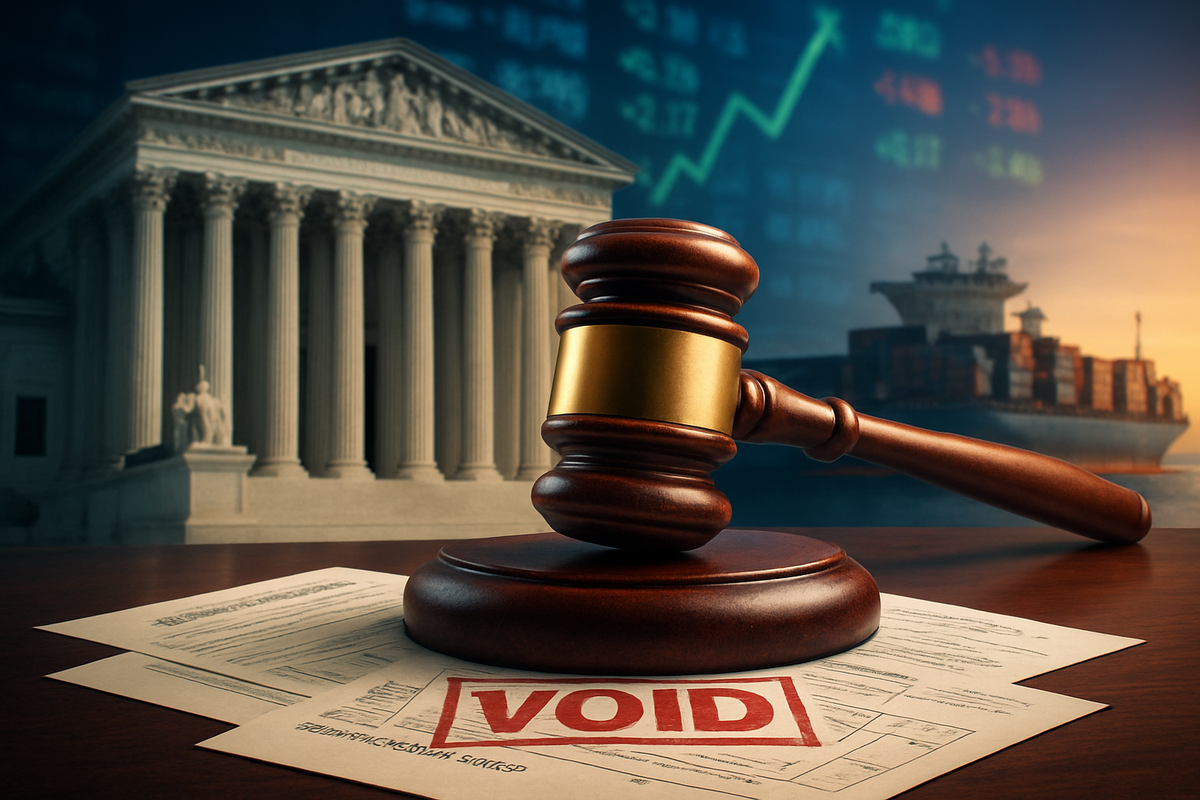
In a historic rebuke of executive overreach, the U.S. Supreme Court has struck down the "Universal Baseline Tariffs" that have defined American trade policy since early 2025. The 6-3 ruling in Learning Resources, Inc. v. Trump, delivered just weeks ago, declared that the administration’s use of the International Emergency Economic Powers Act (IEEPA) to levy broad duties on nearly all imported goods was an unconstitutional exercise of the "taxing power" reserved for Congress. As of today, April 13, 2026, the immediate implications are a chaotic unwinding of billions of dollars in duty collections and a frantic pivot by the White House to alternative, time-limited legal authorities to keep its protectionist agenda alive.
The ruling has triggered a "recalibration" across global financial markets. While the decision initially sparked a relief rally in late February, the subsequent introduction of "Plan B" tariffs under Section 122 of the Trade Act of 1974 has reintroduced volatility. Investors are now grappling with a divided landscape: a massive liquidity injection from court-ordered tariff refunds is colliding with a new, 150-day "ticking clock" on trade surcharges that threatens to disrupt the second half of 2026.
A Constitutional Firewall Against the 'Trade War 2.0'
The Supreme Court’s decision marks the culmination of a year-long legal siege against the administration’s "Trade War 2.0." The litigation began almost immediately after the April 2, 2025, announcement of a 10% universal baseline tariff, which was justified by the executive branch as a response to a "national economic emergency." Chief Justice John Roberts, writing for the majority, invoked the "Major Questions Doctrine," asserting that if Congress intended to delegate the power to impose trillions of dollars in taxes via tariffs, it would have done so with "exceeding clarity"—a level of specificity notably absent from the decades-old IEEPA statute.
The timeline of this legal earthquake has been swift. Following the 2025 executive order, hundreds of importers filed suit in the Court of International Trade. By November 2025, as the government had already collected an estimated $133 billion in new revenue, the Supreme Court agreed to fast-track the case. Today's market jitters stem from the aftermath of that February victory; the administration has responded not by abandoning tariffs, but by pivoting to Section 122 "Balance-of-Payments" authority. This new regime, which went into effect in March, imposes a 15% surcharge but carries a mandatory 150-day expiration date—setting a "cliff" for July 24, 2026, that has every major trading desk on edge.
Winners, Losers, and the 'Refund Collateral' Phenomenon
The shift from the illegal IEEPA tariffs to the temporary Section 122 regime has created a stark divide in corporate America. Among the hardest hit is Walmart Inc. (NYSE: WMT). While the previous regime allowed for some product-specific exclusions on consumer staples, the new Section 122 surcharge is a "universal" hammer. As a high-volume, low-margin retailer, Walmart has been forced to pass these costs directly to consumers, leading to a visible spike in the prices of imported household goods this morning. Similarly, Apple Inc. (NASDAQ: AAPL) finds itself in a complex position. Although the 15% Section 122 rate is lower than the 35% duties some components faced in late 2025, the loss of exclusions on its massive hardware stack could lead to a $30 billion annual hit to its bottom line if the surcharges remain in place.
Conversely, some "winners" are emerging from the legal wreckage. General Motors (NYSE: GM) and other domestic manufacturers are benefiting from a "non-stacking" rule recently implemented by Customs and Border Protection, which ensures the new 15% surcharge does not compound with existing steel and aluminum duties. However, the most fascinating trend in the market today is "Refund Collateralization." With the government estimated to owe between $130 billion and $166 billion in refunds for the struck-down tariffs, major importers are now using these pending government claims as collateral to secure high-interest bridging loans from banks like JPMorgan Chase & Co. (NYSE: JPM) and Goldman Sachs Group Inc. (NYSE: GS). This creative financing is currently the only lifeline for mid-sized manufacturers struggling with the cash-flow crisis caused by a year of illegal duty payments.
Recalibrating for a Volatile 2026
The wider significance of this ruling cannot be overstated; it effectively ends the era of "tariff-by-tweet" and returns the keys of trade policy to the halls of Congress. Economists have spent the last 48 hours frantically revising their 2026 projections. Goldman Sachs has upgraded its U.S. GDP growth forecast to 2.6% for the year, betting that the $160 billion refund injection will act as a significant demand catalyst. However, inflation remains the "sticky" elephant in the room. Even with the SCOTUS win for free trade, the effective U.S. tariff rate remains at 10.3%—nearly five times higher than 2024 levels—keeping PCE inflation anchored near 3.3%.
This event fits into a broader trend of "regulatory whiplash" that has characterized the mid-2020s. The ripple effects are already being felt by international partners. Mexico and Canada, which were largely shielded from the initial 2025 tariffs via exclusions, are now caught in the "universal" net of the Section 122 pivot. This has prompted retaliatory threats from Ottawa and Mexico City, suggesting that the "de-globalization" trend is merely shifting shape rather than reversing. The SCOTUS ruling establishes a historical precedent that will likely limit the trade-war powers of any future administration, yet in the short term, it has created a legislative "dead zone" where trade policy is dictated by 150-day emergency windows.
The July Cliff: What Comes Next?
The market is now laser-focused on the "July 24 Cliff." Because the current Section 122 tariffs expire automatically without congressional approval, the next 90 days will be a period of intense lobbying and political horse-trading. There are three primary scenarios on the table: Congress could codify the tariffs into law, the administration could launch new "Section 301" investigations to target specific sectors like EVs and semiconductors, or the tariffs could simply lapse, leading to a massive, albeit temporary, deflationary shock.
Strategic pivots are already underway. Companies that had begun "near-shoring" to Mexico are now reassessing those investments as the universal nature of the Section 122 surcharge erases the geographic advantages of the USMCA region. In the coming months, the biggest market opportunity may lie in "Tariff Arbitrage"—companies with the supply chain agility to reroute goods or adjust pricing ahead of the July expiration will likely outperform. However, the risk of a "tariff bomb" remains; just this morning, rumors of a 50% duty on Chinese imports as a national security measure caused a sharp sell-off in NVIDIA Corp. (NASDAQ: NVDA) and other high-tech players.
Final Outlook: A Market in Transition
The Supreme Court’s decision to strike down the universal tariffs is a landmark victory for the separation of powers, but for the financial markets, it is a double-edged sword. While it clears a path for billions in corporate refunds, it has also pushed the administration into a corner, leading to more erratic, short-term trade measures. The "recalibrated" 2026 is an economy defined by massive liquidity on one hand and extreme policy uncertainty on the other.
Investors should watch the Court of International Trade hearings scheduled for later this afternoon, as they will provide the first clues on whether the "Section 122" pivot will also face a successful constitutional challenge. For now, the "tariff exhaustion" among market participants is palpable. Moving forward, the strength of the U.S. consumer will be tested by the transition from illegal taxes to temporary surcharges, and the ability of the Treasury to efficiently process $160 billion in refunds will be the most critical "macro" story of the summer.
This content is intended for informational purposes only and is not financial advice.