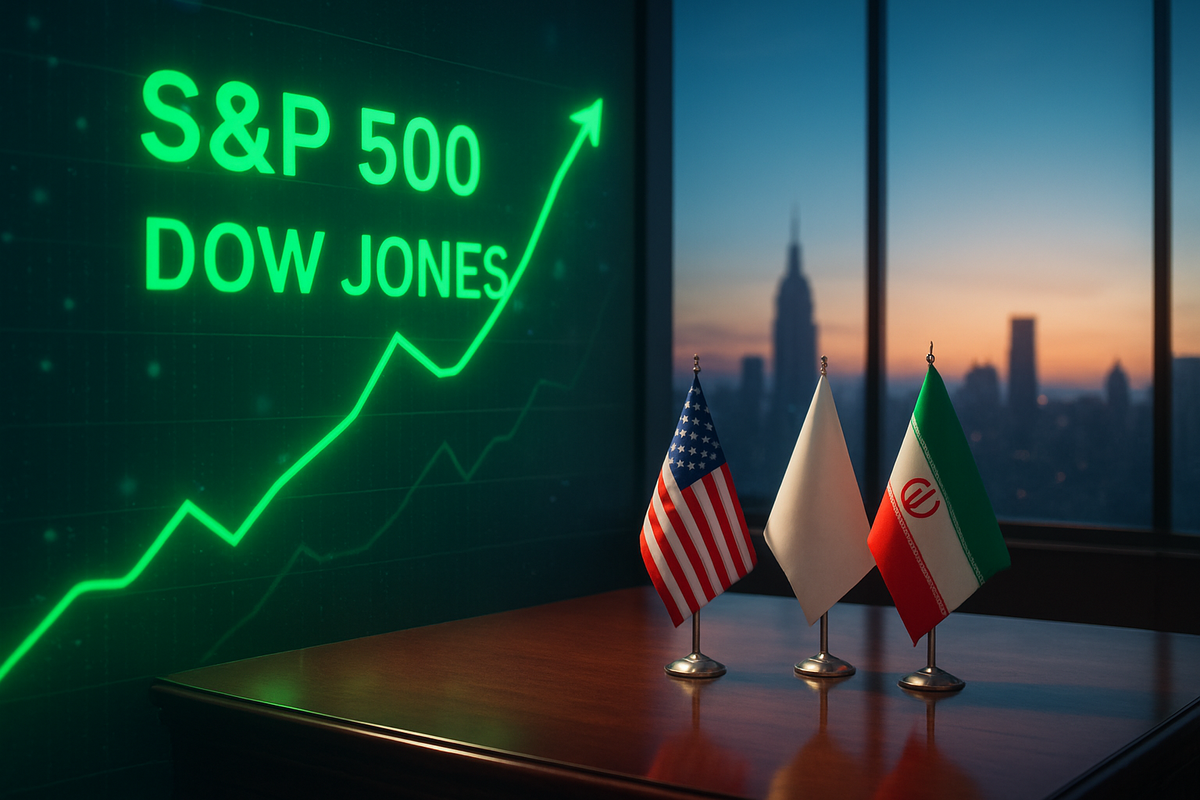
Wall Street roared to life on Friday, April 10, 2026, as the U.S. State Department confirmed a two-week "humanitarian and diplomatic pause" in hostilities with Iran. The announcement, which follows nearly two years of escalating maritime skirmishes and direct missile exchanges, triggered a massive relief rally across global equity markets. The SPDR S&P 500 ETF Trust (NYSEARCA: SPY) surged 2.5%, while the Dow Jones Industrial Average jumped over 1,300 points, marking its best single-day performance of the year.
The ceasefire, mediated by officials in Oman and Qatar, aims to provide a cooling-off period for high-level negotiations regarding maritime security in the Strait of Hormuz and the future of uranium enrichment limits. For investors who have spent much of 2025 and early 2026 hedging against the threat of a full-scale regional war, the news offered a long-awaited "risk-off" signal, though analysts warn that the underlying geopolitical tensions remain far from resolved.
The Path to the Pause: Diplomacy in the Shadow of Conflict
The breakthrough reported today is the culmination of a tense timeline that began in late 2024. Following a series of direct military confrontations in early 2025—frequently referred to as the "Twelve-Day War"—the Middle East has been locked in a high-stakes stalemate. Throughout early 2026, the U.S. maintained a heavy naval presence in the Persian Gulf to protect commercial shipping, a move that kept energy markets on edge and global supply chains under significant strain.
The immediate catalyst for the ceasefire appears to have been a secret multi-day summit in Muscat. Key stakeholders, including representatives from the U.S. National Security Council and the Iranian Foreign Ministry, reportedly reached an agreement to suspend all drone and missile activity for 14 days starting at midnight tonight. Initial market reactions were instantaneous: as the news crossed the wires, West Texas Intermediate (WTI) crude oil plummeted over 14%, dropping below the psychological $95 per barrel mark, as the "war premium" that has supported prices for months evaporated in a matter of hours.
Winners and Losers: A Reversal of Fortunes
The shift from combat to communication has reshuffled the deck for public companies. Major airlines, which have struggled with astronomical jet fuel costs throughout 2025, were among the day's biggest winners. United Airlines Holdings Inc. (NASDAQ: UAL) and American Airlines Group Inc. (NASDAQ: AAL) saw their shares climb 7% and 6.2%, respectively, as investors bet on widening profit margins following the crash in oil prices. Similarly, consumer bellwethers like Apple Inc. (NASDAQ: AAPL) benefitted from the broader market optimism, with the tech giant gaining 3.1% on hopes that a more stable global environment will bolster consumer spending and ease logistics bottlenecks.
Conversely, the defense and energy sectors faced significant headwinds. Defense stalwarts like Lockheed Martin Corporation (NYSE: LMT) and Northrop Grumman Corporation (NYSE: NOC) saw their shares slip by 1.3% and 1.1%, respectively. The decline followed reports that the Pentagon may seek to reduce its "emergency conflict funding" by as much as $100 billion if the ceasefire leads to a permanent de-escalation. Energy giants were also hit hard; Exxon Mobil Corporation (NYSE: XOM) fell 4.5% as the sudden drop in crude prices threatened the record-breaking quarterly profits the company has enjoyed during the period of heightened tension.
The Wider Significance: Inflation and Historical Precedents
Beyond the immediate price action, the ceasefire carries profound implications for global monetary policy. The persistent threat of war has been a primary driver of "geopolitical inflation" over the last 18 months, complicating the Federal Reserve’s efforts to stabilize prices. If the two-week truce holds and leads to a sustained reduction in energy costs, it could provide the Fed with the "green light" to pivot toward interest rate cuts sooner than previously anticipated.
Market historians are already comparing this week's rally to the post-1991 Gulf War recovery. In that era, the cessation of hostilities led to a double-digit jump in the S&P 500 within three months. However, the current situation more closely mirrors the volatility of the 2015 JCPOA signing, where initial optimism was eventually tempered by the complexities of long-term compliance. The ripple effects are also being felt by international shipping conglomerates and regional players, as the risk of a "snapback" in hostilities remains the primary concern for risk managers.
What Comes Next: A Fourteen-Day Clock
The financial world is now focused on the April 24 deadline, when the temporary ceasefire is set to expire. The short-term goal for diplomats is to transition this pause into a "Phase Two" framework, which would include a formal return to the negotiating table for a comprehensive nuclear and security treaty. For corporations, this period requires a delicate strategic pivot. Companies that have over-invested in supply chain redundancies may find themselves with excess capacity if trade routes fully reopen, while energy-intensive industries must decide whether to lock in current fuel prices or bet on further declines.
Potential scenarios range from a historic peace accord to a sudden resumption of hostitilites. Should the talks fail by late April, markets could experience a "whiplash" effect, potentially erasing today's gains in a single trading session. Investors are closely monitoring satellite imagery of Iranian ports and U.S. carrier strike group movements for any signs of a "snapback" in military readiness that would signal the end of the diplomatic window.
Wrap-Up: A Turning Point or a Temporary Reprieve?
The April 10 ceasefire represents a critical crossroads for the global economy. While the 2.5% surge in the S&P 500 reflects a market desperate for stability, the fragility of the agreement cannot be overstated. The key takeaways for investors are clear: energy and defense stocks are losing their conflict-driven premiums, while consumer discretionary and transportation sectors are reclaiming their roles as growth drivers.
Moving forward, the market will likely trade in a "headline-driven" environment, sensitive to every leak from the continuing talks in Oman. Investors should watch for the 10-year Treasury yield and the VIX "fear gauge" as indicators of whether this optimism is truly taking root or if it is merely a short-covering rally in a broader bear market. For now, the world—and the markets—are breathing a sigh of relief, however brief it may be.
This content is intended for informational purposes only and is not financial advice.