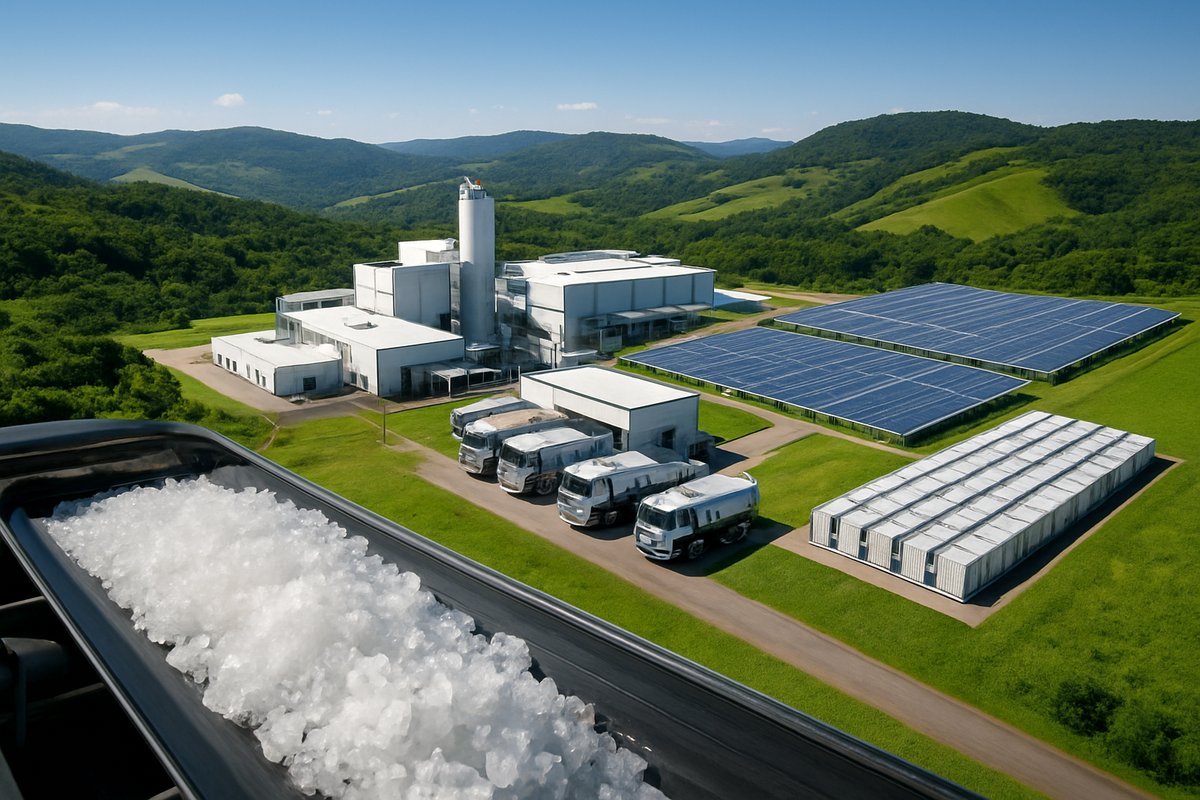
As of March 31, 2026, the global lithium market stands at a critical crossroads, balancing a fragile price recovery with a bifurcated electric vehicle (EV) landscape. Amidst this uncertainty, Sigma Lithium Corp (NASDAQ: SGML) has emerged as a standout performer, reporting a series of strategic milestones that have solidified its position as the premier low-cost, high-sustainability producer in the Americas. By aggressively slashing operational costs and securing innovative "production-backed" financing, the company has successfully navigated the "lithium winter" of 2025 to enter 2026 on a trajectory of triple-digit growth.
The company’s recent Q4 2025 financial results and subsequent Q1 2026 updates reveal a business that has prioritized cash flow and balance sheet health over raw volume during the recent industry downturn. With lithium prices finally stabilizing around $17,000 per tonne for carbonate equivalent, Sigma Lithium’s "Quintuple Zero" strategy—focusing on zero carbon, zero tailings, zero hazardous chemicals, zero fossil fuels, and zero water waste—is proving to be a competitive moat that rivals larger, more established incumbents.
Direct Control and Cost Rationalization: The Road to 47% Margins
The cornerstone of Sigma Lithium's recent success has been a radical shift in its operational philosophy. In late 2025, the company moved away from its reliance on third-party mining contractors at its Grota do Cirilo project in Brazil, bringing all mining and processing operations under direct management. This transition was not without its initial hurdles, but by the end of 2025, the results were undeniable: Sigma reported a staggering 77% year-over-year reduction in quarterly operating costs. This efficiency drive has pushed the company’s all-in sustaining cost (AISC) down to approximately $592 per tonne of concentrate, allowing it to maintain a healthy 47% operating cash margin even when prices were at their 2025 lows.
Beyond traditional cost-cutting, Sigma has successfully monetized what was once considered waste. In March 2026, the company announced the sale of 400,000 tonnes of "high-purity lithium fines"—reprocessed dry-stacked tailings—which generated nearly $20 million in additional profit for the quarter. This new revenue stream effectively turns environmental remediation into a high-margin product, a move that has been widely praised by ESG-focused institutional investors. The timeline of these events shows a company that spent 2025 "battening down the hatches" to ensure it would be the first to benefit from the price rebound expected in the latter half of 2026.
Key stakeholders, including the Brazilian National Development Bank (BNDES), have doubled down on their support. In late 2024, BNDES approved a BRL 487 million ($86 million) 16-year loan to fund Sigma’s "Greentech" expansion, a vote of confidence in the company’s ability to drive regional economic growth. This capital, combined with a 35% reduction in total debt over the past year, has placed Sigma in a rare position of financial strength while its peers struggle with high-interest debt loads.
Winners and Losers in the New Lithium Order
As Sigma Lithium (NASDAQ: SGML) fortifies its market share, the competitive landscape is being redrawn. The clear "winners" in this environment are the Tier 1 battery manufacturers and automotive OEMs that have secured long-term, low-carbon supply. LG Energy Solution (KRX: 373220), which holds a legacy six-year binding deal with Sigma, stands to benefit from a reliable stream of high-grade concentrate as it expands its North American battery plants. Similarly, Mitsubishi Corp (OTC: MSBHF) and investors associated with the Lundin Family have seen their strategic patience rewarded as Sigma transitions from a developer to a major industrial player.
Conversely, the "losers" of the current market cycle are the high-cost, high-carbon lithium producers, particularly those operating in jurisdictions with less favorable environmental regulations. Major players like Albemarle Corporation (NYSE: ALB) and Sociedad Química y Minera de Chile (NYSE: SQM) have faced increasing pressure to match Sigma's cost profile and environmental standards. Producers who relied on expensive lepidolite or high-cost spodumene imports to China have found themselves sidelined as the market shifts toward "green" premiums and localized supply chains.
The shifting demand for EVs also creates a divide. While North American demand has cooled recently, dropping 36% year-to-date in early 2026 due to evolving federal policies, European markets have surged by 21%. Sigma’s ability to ship to both Atlantic markets gives it a flexibility that many Asian-centric producers lack. Companies like Tesla Inc (NASDAQ: TSLA) and BYD Company (OTC: BYDDF), which are navigating this regional demand volatility, are increasingly prioritizing suppliers who can provide not only volume but also the carbon-neutral credentials required by new European and North American regulations.
Broader Industry Significance and the ESG Premium
The strategic evolution of Sigma Lithium is a bellwether for the broader battery metals industry. It signals the end of the "growth at any cost" era and the beginning of a period focused on operational excellence and environmental stewardship. Sigma’s success in achieving a carbon-neutral footprint while remaining a low-cost producer debunked the long-held industry myth that "green" lithium must be prohibitively expensive. This has significant implications for global policy, as regulators in the EU and the U.S. increasingly implement carbon border adjustment mechanisms and "battery passports" that penalize high-carbon production.
Furthermore, Sigma’s reliance on the BNDES for long-term financing highlights a growing trend of "resource nationalism" and strategic regionalism. By positioning itself as the "Green Lithium" champion of the Americas, Sigma is leveraging Brazil's renewable energy grid—which provides 90% of the project's power—to create a sustainable alternative to the dominant Chinese supply chain. This fits into a wider geopolitical trend where Western OEMs are desperate to diversify their sourcing away from high-risk or high-emission jurisdictions.
The emergence of Battery Energy Storage Systems (BESS) as a major demand driver in 2026 has also played into Sigma's hands. While passenger EV demand has been volatile, the explosion of grid-scale storage has provided a more stable price floor for spodumene concentrate. Sigma's high-purity product is particularly well-suited for the high-cycle life requirements of BESS, allowing the company to pivot its sales strategy as the market for heavy-duty electric trucks and stationary storage continues to outperform consumer automotive segments.
Looking Ahead: The Path to Phase 2 and 3
The next 18 to 24 months will be a period of rapid physical expansion for Sigma Lithium. With the successful "production-backed" financing of $146 million in new offtake prepayments secured in early 2026, the company has officially resumed civil construction for its Phase 2 expansion. This project is on track to double total capacity to 520,000 tonnes per annum (tpa) by early 2027. Preliminary work for Phase 3 is already underway, with the ultimate goal of reaching 770,000 tpa—equivalent to approximately 120,000 tonnes of Lithium Carbonate Equivalent (LCE)—by 2028.
In the short term, investors will be watching for the successful commissioning of the second Greentech plant and the stabilization of the North American EV market. A potential pivot toward more aggressive vertical integration, such as local refining into lithium chemicals, remains a long-term possibility, though management currently seems focused on maximizing the efficiency of its concentrate operations. The biggest challenge remains the potential for a renewed supply glut if other major projects come online simultaneously, though Sigma’s low-cost profile provides a significant buffer against such a scenario.
Conclusion: A New Standard for the Battery Age
Sigma Lithium’s journey through 2025 and into early 2026 serves as a masterclass in strategic resilience. By bringing operations in-house, monetizing waste, and securing non-dilutive financing, the company has not only survived a period of intense market volatility but has also set a new standard for what a modern mining company should look like. The transition from a promising developer to a high-margin, environmentally conscious industrial giant is nearly complete.
For the market, the message is clear: the future belongs to producers who can combine low costs with a zero-carbon footprint. As we move through 2026, the focus for investors will shift from Sigma’s survival to its scalability. With a supply deficit looming on the horizon for late 2026 and 2027, Sigma Lithium is perfectly positioned to capture the next upcycle in the energy transition. Market participants should keep a close eye on the Phase 2 construction progress and the company's continued ability to innovate in the monetization of its "Quintuple Zero" tailings.
This content is intended for informational purposes only and is not financial advice.