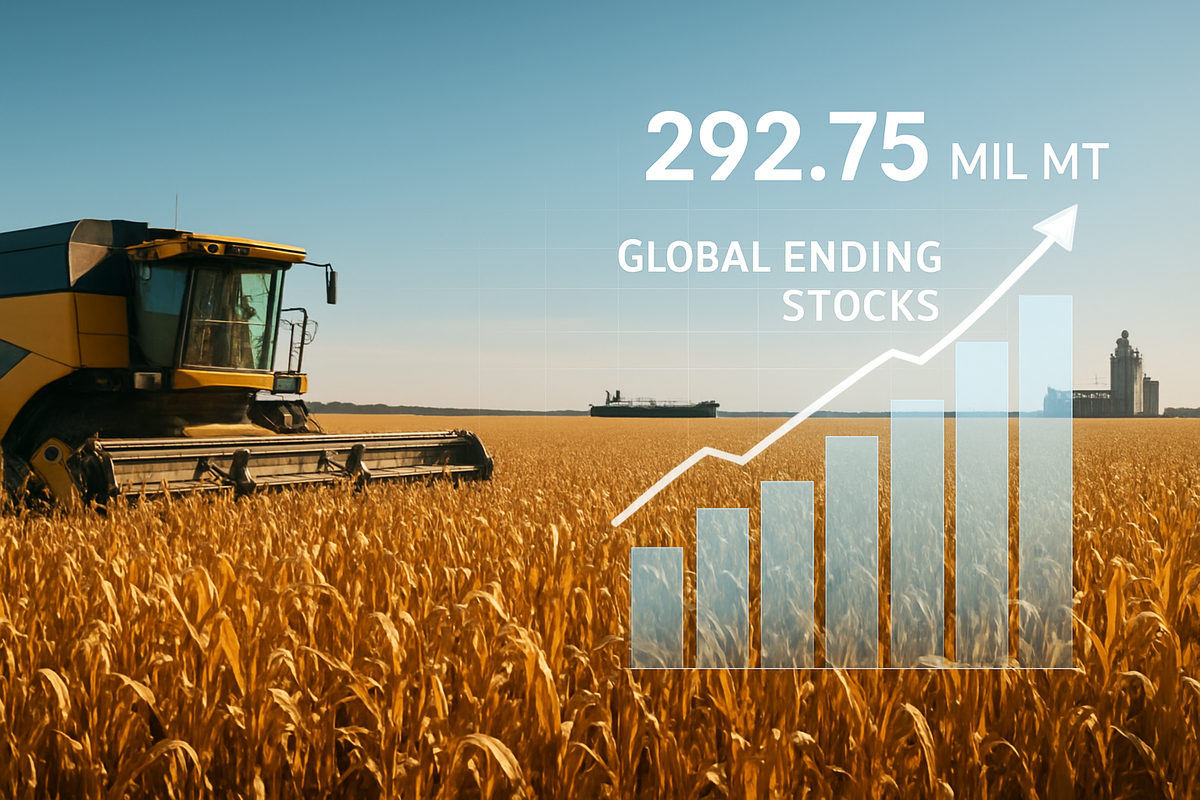
The global agricultural landscape shifted significantly this month following the release of the U.S. Department of Agriculture’s (USDA) March 2026 World Agricultural Supply and Demand Estimates (WASDE) report. In a move that caught commodity traders off guard, the USDA revised global corn ending stocks upward to a staggering 292.75 million metric tons (MMT) for the 2025/26 marketing year. This figure comfortably exceeded the consensus analyst expectation of 288.98 MMT, signaling a deepening surplus that has sent shockwaves through the Chicago Board of Trade.
Despite persistent geopolitical volatility in Eastern Europe and logistical bottlenecks in South America, the "wall of corn" continues to grow. The surplus is largely driven by resilient production in Ukraine and an expansive harvest in Brazil, both of which have defied earlier pessimistic forecasts. As of March 25, 2026, the immediate implication for the market is a sustained downward pressure on corn prices, which are currently hovering in the $4.10 to $4.50 per bushel range—a stark contrast to the inflationary pressures seen in other sectors of the economy.
Resilience Amidst Conflict: The Factors Behind the Surplus
The March 10, 2026, WASDE report provided a granular look at why the global supply glut is persisting. The most notable adjustment came from Ukraine, where the USDA raised the 2025/26 production forecast to 30.7 MMT, an increase of 1.7 MMT from the February estimates. Despite the ongoing regional conflicts and skyrocketing fertilizer costs, Ukrainian farmers have managed to maintain active rail and port shipments, with exports for the marketing year holding steady at approximately 22 MMT. This resilience has kept a steady stream of grain flowing into global markets, preventing the supply crunches that many had feared earlier in the decade.
In South America, Brazil’s "Safrinha" or second-crop corn has become a juggernaut. The USDA raised Brazil’s total production estimate to 132 MMT, a 1 MMT increase from the previous month. While the first-crop harvest has been hampered by a slow soybean cycle—reaching only 50% completion compared to 72% at this time last year—the sheer scale of the second-crop planting (now at 91%) suggests that Brazil is poised to remain the world's leading exporter. Private analysts are even more bullish than the USDA, with some projecting the final Brazilian tally could reach as high as 140 MMT if the late April rains hold.
The market reaction to these figures was swift. Upon the report’s release, corn futures initially dipped as the realization of a nearly 293 MMT global cushion settled in. Traders who had bet on supply tightening due to Argentine heatwaves (where production was actually cut by 1.0 MMT to 52 MMT) found themselves repositioning as the gains in Brazil and Ukraine more than offset the losses in the Southern Cone.
Corporate Winners and Losers in a Low-Price Environment
The surplus creates a divergent landscape for the major public companies serving the agricultural sector. For grain merchandising giants like Bunge Global SA (NYSE: BG) and Archer-Daniels-Midland (NYSE: ADM), the high "velocity" of grain movement is a significant tailwind. Bunge, in particular, has seen its stock soar over 30% year-to-date as of late March 2026. The company’s merger with Viterra has allowed it to navigate global disruptions with unprecedented efficiency, prompting analysts to label it a "Strong Buy." While lower corn prices can squeeze margins, the sheer volume of exports and the volatility in trade routes provide ample opportunity for merchandising profits.
Conversely, the manufacturing sector is feeling the pinch. Deere & Co (NYSE: DE), the world's largest farm equipment maker, saw its stock dip in early March as investors fretted over a "cyclical trough." Lower corn prices directly impact farmer liquidity, leading to a projected 15% to 20% decline in large equipment demand in North America for the 2026 fiscal year. While Deere has raised its net income guidance to $4.5B–$5.0B, its "Production & Precision Agriculture" segment is facing margin compression as farmers delay high-ticket purchases in favor of maintaining cash flow.
Corteva (NYSE: CTVA) occupies a middle ground. While it is sensitive to total acreage, its focus on premium seed genetics and proprietary traits has allowed it to insulate its margins. With U.S. corn acreage projected at a robust 98.8 million acres for the upcoming season, Corteva is outperforming rivals like Nutrien (NYSE: NTR) and Mosaic (NYSE: MOS), who are more heavily exposed to the volatile fertilizer markets. Corteva’s management has guided for 7% Operating EBITDA growth in 2026, signaling that high-tech agriculture remains a defensive play even when commodity prices are soft.
The Broader Market Context: Energy vs. Agriculture
The current corn surplus is unfolding against a bizarre macroeconomic backdrop where energy prices are decoupled from agricultural commodities. As of late March 2026, crude oil is trading near $120 per barrel due to renewed tensions in the Middle East. Historically, high oil prices pull corn prices upward due to the ethanol link; however, the massive supply of corn has acted as a stabilizer. This has created a unique "biofuel pull," where companies like Valero (NYSE: VLO) are seeing increased demand for ethanol as a cheaper oxygenate and fuel extender, potentially providing a floor for corn prices later in the year.
This event fits into a broader industry trend of "yield intensification" in South America. Brazil’s ability to grow two crops a year on the same land has fundamentally changed the global supply-demand balance, making the world less dependent on the U.S. "I-States" (Iowa, Illinois, Indiana) for global food security. However, this shift brings new risks, specifically the vulnerability of the global supply chain to weather events in a single geography. If Brazil’s dry season arrives early in April 2026, the current surplus could evaporate faster than the market expects, leading to extreme price volatility.
Looking Ahead: The 2026 Planting Season
As the Northern Hemisphere enters the critical spring planting window, the market's focus is shifting from the March WASDE data to the upcoming USDA Prospective Plantings report. Short-term, the surplus ensures that there is no immediate threat of a global food shortage, but it also means that American farmers are entering the 2026 season with some of the tightest profit margins in five years. We may see a strategic pivot where U.S. producers shift some corn acreage into soybeans or cotton if corn remains below the $4.30 level.
Long-term, the industry is watching for a "clearing" of the surplus. If Ukraine can maintain its 30+ MMT production levels and Brazil continues its expansion, the era of $6.00 or $7.00 corn may be a distant memory. Market participants should prepare for a period of "volume over value," where the companies that can move, process, and add value to cheap grain—rather than those that simply sell inputs—will emerge as the strategic winners.
Summary and Investor Outlook
The March 2026 WASDE report has confirmed that the global corn market is currently defined by abundance rather than scarcity. The surprise increase to 292.75 MMT in ending stocks highlights the incredible resilience of global agriculture, even in the face of geopolitical and logistical headwinds. For investors, the takeaway is clear: the "Big Ag" cycle has bifurcated. Grain traders (BG, ADM) and high-tech seed providers (CTVA) are finding ways to grow earnings, while equipment manufacturers (DE) are bracing for a prolonged period of cautious spending from their primary customers.
Moving forward, the key indicators to watch will be the April weather patterns in Brazil's Mato Grosso region and the final acreage counts in the U.S. Midwest. While the current surplus provides a comfortable buffer, the high cost of inputs and energy remains a persistent threat to the stability of the 2026/27 crop cycle. Investors should remain focused on companies with strong balance sheets that can weather a "lower for longer" commodity price environment while benefiting from the high volume of global trade.
This content is intended for informational purposes only and is not financial advice.