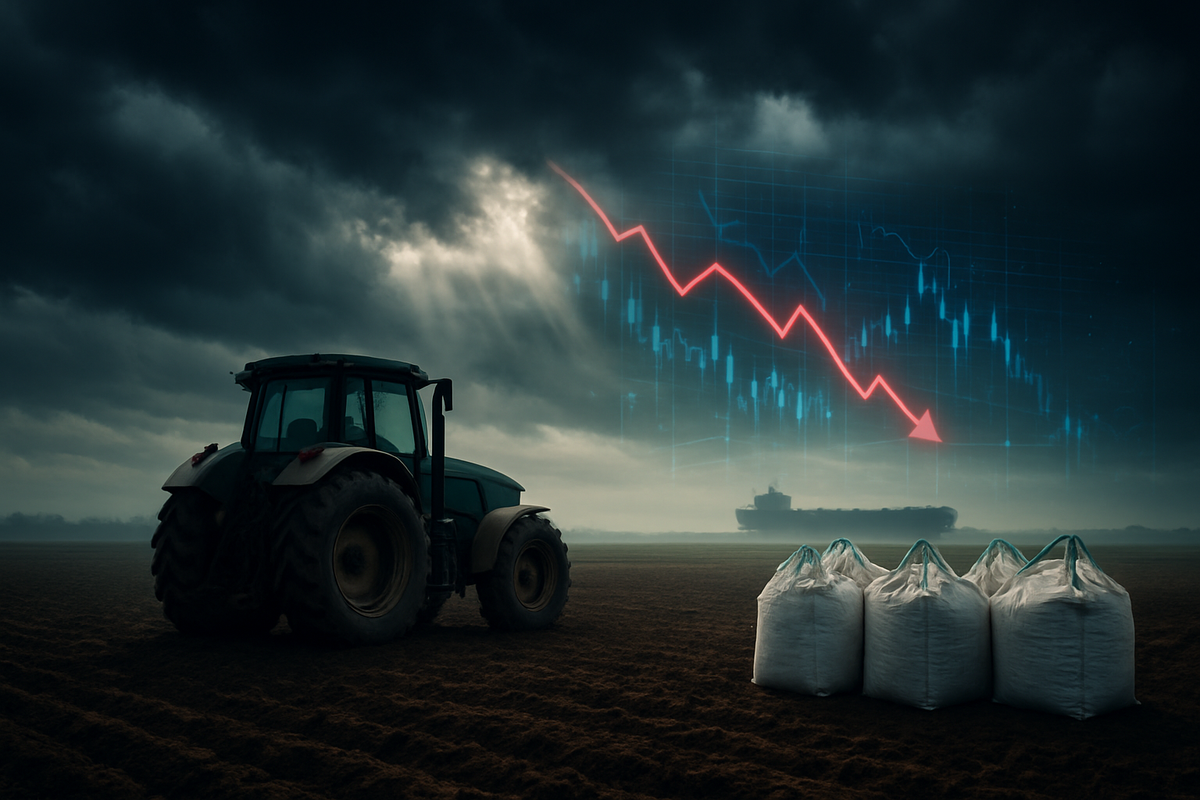
As of March 23, 2026, the global agricultural sector is grappling with a destabilizing supply crisis that threatens to reshape the 2026 and 2027 planting seasons. A convergence of geopolitical conflict in the Middle East and a "sulfur cascade" in the global supply chain has sent fertilizer prices soaring, leaving farmers in the Northern Hemisphere facing some of the most challenging economic conditions in a generation. With urea prices at the Port of New Orleans (NOLA) spiking over 20% in just two weeks to exceed $650 per ton, the immediate impact is a frantic re-evaluation of crop rotations as the spring planting window narrows.
The crisis is not merely a short-term price spike but a structural disruption that analysts warn will persist well into 2027. For the 2026 season, the most visible casualty is nitrogen-heavy corn, which has seen its production costs climb to an estimated $166 per acre. This financial pressure is driving a massive shift in acreage away from corn and toward soybeans, a trend that could lead to significant imbalances in global grain supplies by the end of the year.
A Perfect Storm: Operation Epic Fury and the Sulfur Blockade
The current crisis traces its origins to late February 2026, following a U.S.-led military initiative dubbed "Operation Epic Fury." The operation, aimed at neutralizing regional threats in the Middle East, resulted in the retaliatory closure of the Strait of Hormuz. This single maritime chokepoint is responsible for approximately one-third of the global seaborne fertilizer trade, particularly nitrogen and sulfur exports from hubs in Qatar, Saudi Arabia, and the United Arab Emirates. The sudden removal of this supply has paralyzed global distribution networks, leaving shipments of finished urea and critical inputs physically trapped.
Beyond the immediate loss of nitrogen, the market is reeling from a "sulfur cascade." With 44% of global sulfur trade passing through the region, the blockade has cut off the lifeblood of phosphate production. Sulfur and sulfuric acid are essential for the production of Monoammonium Phosphate (MAP) and Diammonium Phosphate (DAP). Major producers in China and Morocco, who rely on these imports, have begun to curb exports of finished fertilizers to preserve domestic food security, further tightening global supply. This sequence of events has mirrored the supply shocks of 2022 but with a more acute impact on the raw materials needed for complex fertilizers.
The initial market reaction has been one of extreme volatility and "price discovery" as retailers and farmers struggle to secure volumes. In many parts of the U.S. Midwest and Europe, fertilizer retailers have temporarily stopped quoting prices altogether, unable to guarantee delivery or manage the risk of further overnight surges. This uncertainty has left many farmers in a defensive posture, delaying purchases and scaling back application rates, a move that could negatively impact yields for the 2026 harvest.
Corporate Divergence: Winners and Losers in a Volatile Market
The 2026 crisis has created a stark divide among the major public companies in the fertilizer space, largely dictated by their proximity to low-cost feedstocks. CF Industries (NYSE: CF) has emerged as a clear beneficiary. Leveraging its position as a major North American producer with access to relatively stable domestic natural gas prices at the Henry Hub, CF has maintained high margins while capturing the "scarcity premium" in global markets. The company's stock jumped 13% in early March 2026, following upward revisions to its Q1 earnings estimates, as it continues to export high-margin nitrogen to a desperate global market.
Nutrien (NYSE: NTR) has also seen its outlook upgraded to a "Buy" by several major analysts. As the world’s largest producer of potash, the company is ramping up production in Canada to fill the supply gap left by continued sanctions on Russian and Belarusian exports. While Nutrien's nitrogen business is also benefiting from the price surge, its integrated retail network is providing a buffer, helping it manage supply chain logistics better than smaller competitors. However, The Mosaic Company (NYSE: MOS) has faced a more complicated landscape. Despite high phosphate prices, Mosaic’s Florida-based operations have been hampered by the doubling of sulfur costs, leading to a reported $250 million EBITDA hit in the first quarter of 2026.
Conversely, European producers like Yara International (OTC: YARIY) are under immense pressure. High European natural gas prices, which have spiked above €60/MWh due to regional energy tensions, have forced Yara to maintain production curtailments of nearly 25% across its European fleet. This inability to run at full capacity during a price peak highlights the structural disadvantage of European manufacturing in the current energy environment. Furthermore, machinery giants like Deere & Company (NYSE: DE) are closely watching the crisis; while they have seen a slight uptick in orders for soybean-specialized equipment, the overall decline in farm profitability—with corn farmers projected to lose over $200 per acre—could dampen overall capital expenditure in the equipment sector through 2027.
Agricultural Shifts and Global Food Security
The broader significance of this crisis lies in the fundamental shift in global agricultural strategies. For the 2026 planting season, USDA projections suggest corn acreage will drop to roughly 93 million acres, a sharp decline from the nearly 99 million acres planted in 2025. This shift toward soybeans, which require significantly less nitrogen fertilizer, is an economic necessity for many farmers. The "soybean pivot" is no longer just a trend but a survival strategy, as the loss-per-acre for soybeans is estimated to be nearly $75 less than that of corn under current input costs.
This event fits into a larger trend of "resource nationalism," where nations prioritize domestic supply over international trade. Following the precedents set during the 2022 energy crisis, countries are increasingly viewing fertilizers as a matter of national security rather than a global commodity. This shift is likely to lead to more regulatory interventions, such as export taxes or domestic price caps, which could further distort global market signals and lead to long-term inefficiencies in food production.
Historically, such price shocks have led to a "tail" of high food inflation. As fertilizer is the single largest variable cost for grain production, the 2026 price surge will likely manifest in higher grocery prices by early 2027. The ripple effects will be felt most acutely in emerging markets that are dependent on imported grain and fertilizers, potentially leading to renewed concerns over global food stability similar to the "Arab Spring" period or the post-pandemic inflation cycles.
The Long Road to 2027: Strategic Pivots and New Realities
Looking ahead to the 2027 planting season, the market is bracing for a "new normal" where fertilizer prices remain structurally higher than historical averages. Short-term relief is unlikely until the geopolitical situation in the Middle East stabilizes and the Strait of Hormuz is fully reopened to commercial traffic. In the meantime, the industry is accelerating its pivot toward "Green Ammonia" and localized production methods to reduce dependence on volatile global supply chains and fossil fuel feedstocks.
For farmers, the 2027 season will require even more sophisticated management. We are seeing an increase in "second-year soybeans" and the adoption of precision agriculture technologies that allow for ultra-targeted fertilizer application. While these adaptations offer some resilience, they require significant upfront investment, which may be out of reach for smaller operations. Market opportunities may emerge for specialized biological fertilizer companies and tech firms that can demonstrate proven reductions in synthetic fertilizer needs.
The potential for a "second wave" of new capacity in 2027—particularly from projects in Canada and potentially renewed flows from Eastern Europe—remains a wildcard. If this capacity comes online as global demand softens due to the acreage shift, the market could see a sharp correction in late 2027. However, the immediate challenge remains the massive logistical hurdle of moving existing supplies to where they are needed most.
Summary and Investor Outlook
The 2026 fertilizer crisis is a watershed moment for global agriculture, driven by a combination of maritime blockades and soaring input costs. The immediate result is a significant shift in crop acreage and a profitability squeeze for farmers that will likely reverberate through the food supply chain for years. For investors, the key takeaways involve the divergence in performance between North American producers like CF Industries and their energy-starved European counterparts.
Moving forward, the market will be characterized by high volatility and a focus on supply security. Investors should closely monitor natural gas prices at the Henry Hub, any movement toward reopening the Strait of Hormuz, and the USDA's final acreage reports for 2026. The ability of companies to manage input costs—particularly sulfur and natural gas—will be the primary driver of earnings in the coming quarters. As we look toward the 2027 cycle, the agricultural sector's ability to adapt to these high-cost environments will determine the next era of global food production.
This content is intended for informational purposes only and is not financial advice.