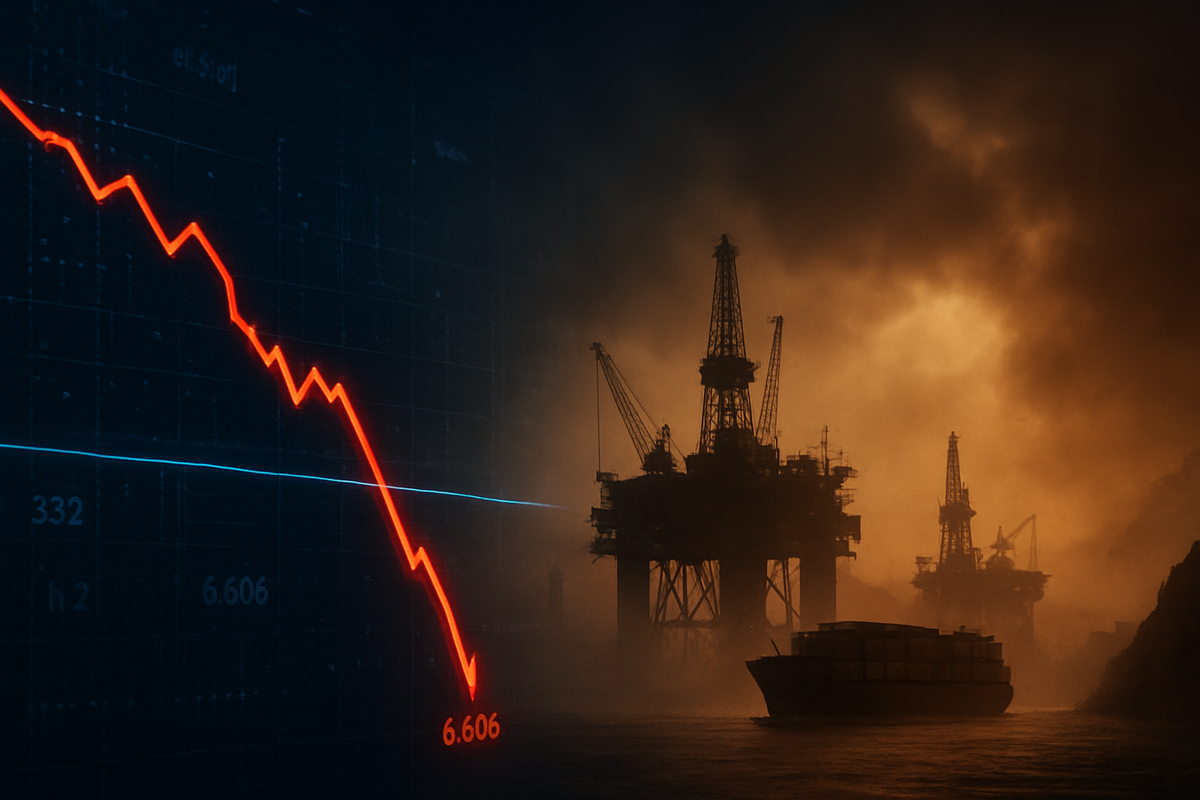
The long-standing resilience of the American equity market faced its most severe test in nearly a year this week. On March 19, 2026, the S&P 500 (INDEXSP: .INX) closed at 6,606, decisively breaking below its 200-day moving average (DMA) of 6,615. This breach marks the first time the index has traded below this critical long-term support level in 214 sessions, effectively ending a streak of dominance that began in May 2025. For U.S. investors, the technical breakdown is more than just a chart pattern; it signals a fundamental transition from a market fueled by the promise of "AI-driven growth" to one constrained by a harsh "geopolitical reality."
The sell-off reflects a growing consensus on Wall Street that the "Goldilocks" era of low inflation and high-tech expansion has been interrupted. As the 6,606 level gave way, the sentiment shift was palpable. Traders who had spent the last 18 months buying every minor dip in technology stocks are now grappling with a landscape defined by regional conflicts, supply chain weaponization, and a resurgence of energy-led inflation. The psychological impact of losing the 200-day DMA—a level often used by institutional algorithms to determine long-term trend health—suggests that the "path of least resistance" for the market has officially shifted from upward to downward.
A Timeline of the Breakdown: From Record Highs to 6,606
The descent to 6,606 was not an overnight occurrence but rather a steady erosion of confidence that began after the S&P 500 hit a record high of 6,978 in late January 2026. Throughout February, the market struggled to maintain its momentum as the initial "AI 2.0" hype—centered on autonomous agentic systems—met the reality of massive capital expenditure requirements. By early March, the narrative shifted from corporate earnings to the escalating conflict in the Middle East. The final catalyst arrived this week as direct military engagement between U.S.-Israeli forces and Iranian assets led to a partial blockade of the Strait of Hormuz, sending Brent crude prices soaring toward $110 per barrel.
The breakdown at 6,606 was triggered by a massive de-risking event during the March 19 trading session. Institutional heavyweights and hedge funds, sensing the vulnerability of the 200-DMA support, accelerated sell orders as the index approached the 6,615 mark. Key stakeholders, including major asset managers like BlackRock (NYSE: BLK) and Vanguard, have noted a significant rotation out of growth-oriented ETFs and into "Old Economy" value plays. The reaction across the floor was one of grim realization; the 214-session streak provided a sense of security that has now been replaced by a "sell-the-rip" mentality.
The Winners and Losers of the New Geopolitical Paradigm
The primary victims of this technical breakdown are the "Magnificent" tech giants that previously carried the index to its heights. Nvidia (NASDAQ: NVDA), the poster child of the AI revolution, saw its shares tumble as investors questioned whether the massive build-out of data centers could be sustained amid rising energy costs and hardware supply risks. Similarly, Microsoft (NASDAQ: MSFT) and Alphabet (NASDAQ: GOOGL) have faced pressure as their "Agentic AI" rollouts, while technologically impressive, have yet to show the immediate margin expansion needed to justify their 2026 valuations in a high-risk environment. Apple (NASDAQ: AAPL) has also been hit hard, caught in the crosshairs of a renewed "reciprocal" trade war characterized by a fresh 15% across-the-board global tariff.
Conversely, the shift to "geopolitical reality" has minted a new class of relative winners. Energy giants like ExxonMobil (NYSE: XOM) and Chevron (NYSE: CVX) are seeing renewed interest as oil supply concerns dominate the headlines. Defense contractors, most notably Lockheed Martin (NYSE: LMT) and Northrop Grumman (NYSE: NOC), have become the ultimate hedge for investors looking to protect capital against the rising tide of global conflict. Furthermore, utility companies such as NextEra Energy (NYSE: NEE) are outperforming the broader market, as their domestic focus and essential service nature provide a sanctuary from the volatility of international trade and tariff wars.
Wider Significance: The Repricing of Risk and the End of AI Dominance
This event fits into a broader industry trend where "Pipes over PowerPoints" has become the mantra for 2026. For three years, the market prioritized software and semiconductor innovation above all else. However, the current breakdown suggests that the physical constraints of the world—energy, shipping lanes, and raw materials—are reasserting their dominance. The ripple effects are being felt by competitors and partners alike; as U.S. tech spending slows, global supply chains in Taiwan and South Korea are bracing for a prolonged "valuation reset" that could last through the remainder of the decade.
The historical precedent for this moment mirrors the market shifts of the mid-1970s and the early 2000s, where geopolitical shocks forced a decade-long transition from growth to value stocks. The regulatory and policy implications are equally significant. With the U.S. government invoking Section 122 of the 1974 Trade Act to impose sweeping tariffs, the era of hyper-globalization appears to be in its final death throes. For investors, this means the "S&P 500" is no longer a monolithic growth engine but a fragmented collection of sectors moving in opposite directions based on their exposure to geopolitical friction.
The Road Ahead: Support Levels and Strategic Pivots
Looking forward, the short-term outlook remains precarious. With the 200-day DMA broken, technical analysts are eyeing the 6,000 level as the next major psychological and structural floor for the S&P 500. A "retest" of the 6,615 level from below is likely in the coming days, but unless there is a significant de-escalation in the Middle East or a reversal of the recent tariff hikes, any bounce is expected to be met with aggressive selling. Investors must now adapt to a high-volatility environment where the Federal Reserve’s ability to "save" the market is hampered by the "second wave" of inflation driven by $110-per-barrel oil.
Strategic pivots are already underway. Many multi-asset portfolios are increasing their weightings in gold and Treasury Inflation-Protected Securities (TIPS) while trimming exposure to high-beta technology. The challenge for 2026 will be identifying companies that possess "geopolitical sovereignty"—those with domestic supply chains and the ability to pass on rising costs to consumers. While the "AI dream" is not dead, it has entered a more sober, long-term phase of implementation that will require patience that many short-term traders simply do not have.
Final Assessment: A New Era for U.S. Markets
The close below 6,606 on March 19, 2026, will likely be remembered as the moment the post-pandemic bull market finally buckled under the weight of global reality. The 214-day streak above the 200-DMA served as a period of extraordinary wealth creation, but it also masked the growing fragility of a tech-heavy index in an increasingly fractured world. As we move into the second quarter of 2026, the focus for investors must shift from "growth at any price" to "resilience at a reasonable price."
In the coming months, the most critical indicators to watch will be the status of the Strait of Hormuz, the impact of the 15% global tariffs on U.S. consumer spending, and whether the 6,000 level can hold if the current correction deepens. The era of easy gains driven by AI optimism has passed; the era of managing through geopolitical reality has begun. For the disciplined investor, this breakdown is not just a warning—it is the starting gun for a new way of evaluating risk and reward in the late 2020s.
This content is intended for informational purposes only and is not financial advice.