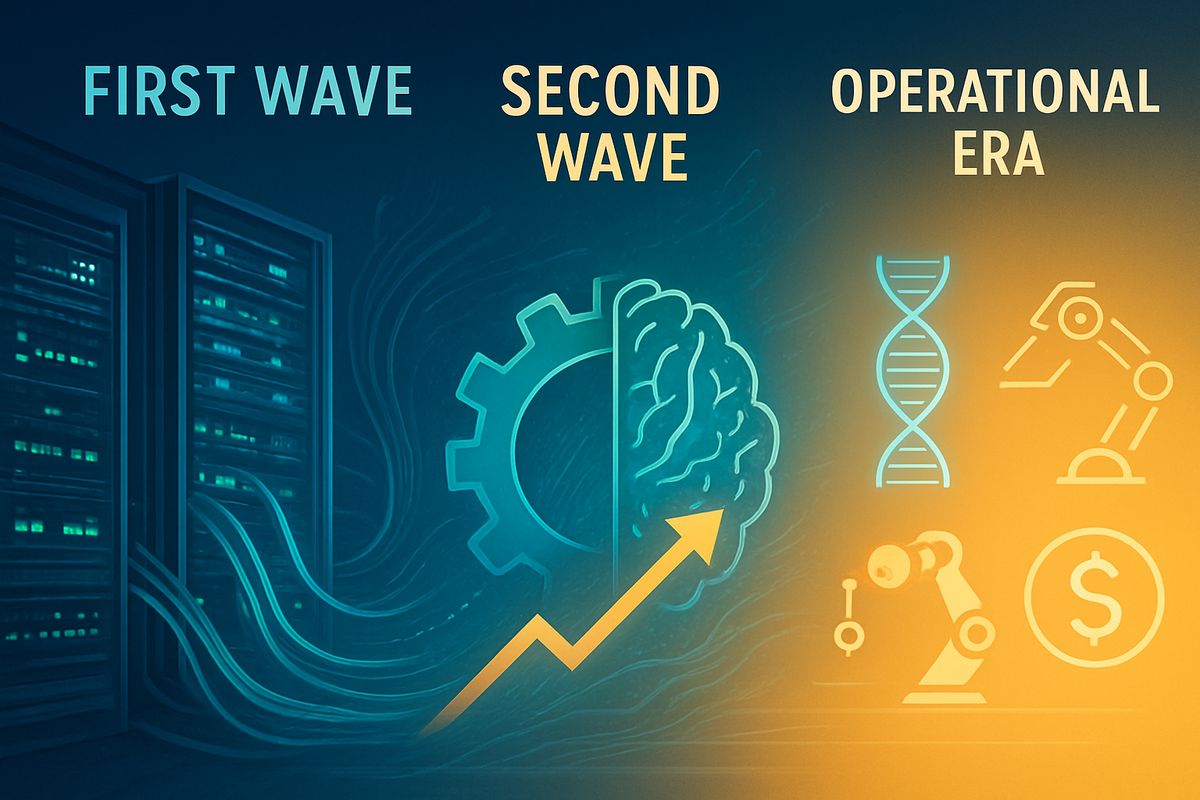
As of January 27, 2026, the global financial markets are witnessing a profound transformation in the artificial intelligence narrative. While 2023 and 2024 were defined by a "land grab" for semiconductor chips and massive data center construction, the narrative in early 2026 has shifted toward the "Second Wave": a period where the focus is no longer on who is buying the hardware, but who is successfully using it to expand margins. This transition has triggered a "Great Rotation" in the equity markets, as investors move away from overextended "Magnificent Seven" giants and toward mid-cap and small-cap companies that are effectively operationalizing AI.
The immediate implications are stark. For the first time since the pandemic era, the Russell 2000 is showing signs of sustained outperformance against the tech-heavy Nasdaq. Companies that were once considered "unsexy" or "legacy" are now the darlings of Wall Street, provided they can demonstrate a clear "AI ROI." The market is no longer rewarding high capital expenditure (CapEx) in a vacuum; it is demanding to see the "Net Value" of AI—where the gross time saved by automation significantly outweighs the costs of implementation and the so-called "Hidden AI Tax" of error correction and output verification.
The timeline leading to this moment was paved with skepticism and staggering investment. In late 2024, the market reached a fever pitch of concern regarding the $475 billion collective spend of the world's largest hyperscalers. Throughout 2025, that skepticism evolved into a rigorous "ROI Appraisal" phase. The Second Wave officially took hold when "Agentic AI"—autonomous systems capable of completing entire complex workflows rather than just generating text—became the standard for enterprise software. This shifted the industry's center of gravity from raw compute power to vertical-specific application.
Key stakeholders in this transition include a new breed of Chief AI Officers (CAIOs) who have replaced traditional CTOs in spearheading the integration of AI into physical products. Initial market reactions were volatile; throughout 2025, several "First Wave" darlings saw their valuations reset as investors realized that owning the "picks and shovels" did not guarantee a share of the "gold." However, by early 2026, the emergence of clear success stories in specialized sectors like healthcare and industrial robotics has provided a new roadmap for growth. This era is defined by operational discipline and "FinOps," where companies obsess over the cost of every AI inference relative to the revenue it generates.
The winners of the Second Wave are those who have successfully bridged the gap between silicon and strategy. TSS Inc. (NASDAQ: TSSI) has emerged as a standout winner, leveraging its partnership with major hardware providers to offer high-margin rack integration for AI server clusters. Their revenue has nearly tripled as they transitioned from a hardware reseller to a mission-critical infrastructure integrator. Similarly, GeneDx Holdings (NASDAQ: WGS) has utilized AI to revolutionize genomic testing, integrating clinical interpretation at a speed that has allowed them to capture significant market share in the diagnostics space.
In the robotics and defense sector, Kraken Robotics (TSX-V:PNG / OTCQX:KRKNF) has seen hyper-growth by deploying AI-powered undersea drones that perform autonomous tasks previously requiring human divers and expensive support ships. On the cloud side, DigitalOcean (NYSE: DOCN) has defied the dominance of the hyperscalers by providing a specialized AI platform tailored for small businesses, leading to a 34% outperformance of the broader market over the past year.
Conversely, the losers are those whose business models are being cannibalized by the very technology they tried to embrace. Chegg (NASDAQ: CHGG) remains the primary cautionary tale, having laid off nearly half its workforce in late 2025 as free AI-driven tutoring tools decimated its subscriber base. High-profile "seat-based" software firms like Atlassian (NASDAQ: TEAM) and Salesforce (NYSE: CRM) are also under pressure. As AI "agents" begin to perform the work of multiple human employees, the traditional "per-seat" licensing model is facing a structural decline, forcing these giants to rapidly pivot to "outcome-based" pricing models that the market has yet to fully trust.
This shift fits into a broader historical precedent: the "Installation Phase" vs. the "Deployment Phase" of technology cycles, much like the build-out of fiber optics in the late 1990s led to the software-as-a-service (SaaS) boom of the 2010s. The 2023-2024 era was the installation; 2026 is the deployment. The ripple effects are being felt across the labor market, where the "Productivity Paradox" is in full swing. While 85% of employees report saving significant time using AI, roughly 40% of those gains are currently being lost to "rework," highlighting a massive opportunity for companies that can improve AI accuracy and reliability.
Regulatory and policy implications are also mounting. As AI moves from the cloud to the "edge"—integrated into drones, medical devices, and factory floors—regulators are shifting their focus from data privacy to physical safety and liability. Historically, this transition resembles the electrification of factories in the early 20th century. It wasn't the companies that built the dynamos that won the long game; it was the manufacturers who redesigned their factory floors to take advantage of distributed power. In 2026, the market is finally identifying the "factory redesigners" of the AI age.
Looking ahead, the next 12 to 24 months will likely see a wave of consolidation. Large-cap tech companies, sitting on massive cash reserves but facing slowing organic growth, are expected to aggressively acquire small-cap AI leaders that have proven their operational ROI. We may also see a shift in how companies report earnings, with "AI-driven margin expansion" becoming a standard non-GAAP metric that analysts use to differentiate between leaders and laggards.
Strategically, firms will need to pivot from "AI experimentation" to "AI specialization." The era of general-purpose chatbots is fading, replaced by hyper-niche agents trained on proprietary, private datasets. The primary challenge will be the "Hidden AI Tax"—the rising cost of maintaining and auditing autonomous systems. Companies that can solve this "trust and verification" problem will likely be the next trillion-dollar entities, as the market moves toward a future where AI handles the majority of routine administrative and operational tasks.
In summary, the Second Wave of AI represents the transition from hype to harvest. The market has moved past its infatuation with the "Magnificent Seven" and is now rewarding agility, efficiency, and tangible results within the small-cap and mid-cap space. The key takeaway for 2026 is that the value of AI is no longer found in its novelty, but in its ability to drive sustainable, bottom-line growth.
Investors should watch for companies that are reporting "Net Value" gains and those that are successfully navigating the shift from per-seat pricing to agentic, outcome-based models. As we move further into 2026, the divide between the companies that merely "use" AI and those that are "transformed" by it will only widen. The "Great Rotation" is not just a market trend; it is a fundamental re-rating of the global economy based on the new realities of AI operationalization.
This content is intended for informational purposes only and is not financial advice.