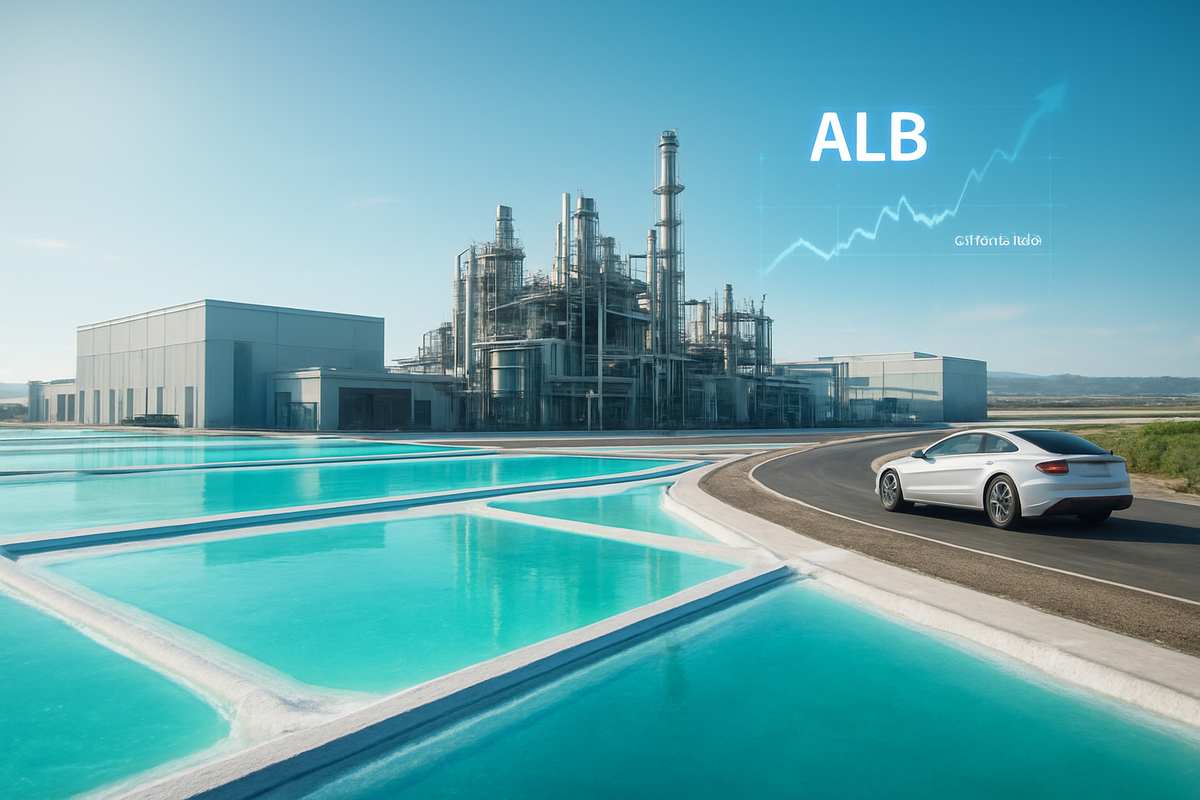
In a stunning reversal of fortune for the critical minerals sector, Albemarle Corp (NYSE: ALB) surged to a new 52-week high of $151.00 this week, marking a definitive end to the "lithium winter" that chilled investor sentiment throughout 2024. The Charlotte-based lithium giant, which saw its valuation crater to nearly $50.00 just eighteen months ago, has become the poster child for a broader commodity recovery driven by a tightening global supply and a radical shift in U.S. industrial policy.
The rally, which has seen the stock climb over 76% year-to-date as of December 26, 2025, signals a renewed confidence in the electric vehicle (EV) transition. As lithium carbonate prices stabilize between $11,500 and $15,000 per metric ton—up significantly from the $9,000 lows seen in late 2024—investors are betting that the "white gold" rush is entering a more sustainable, policy-supported growth phase.
The Road to $151: A Timeline of Recovery
The ascent to this week's 52-week high was not a linear journey. It began with a painful period of consolidation in late 2024 and early 2025, during which Albemarle was forced to slash its capital expenditure to approximately $600 million and defer several high-profile projects, including the Richburg, South Carolina refinery. These austerity measures, initially met with skepticism, proved vital in preserving the company's balance sheet while the global market worked through a massive supply glut of spodumene and lepidolite.
The turning point arrived in mid-2025 with the passage of the "One Big Beautiful Bill Act" (OBBBA), a landmark piece of legislation that redirected billions in federal funding from consumer EV tax credits toward direct upstream industrial subsidies. By late summer, the U.S. government had designated Albemarle’s Kings Mountain Mine in North Carolina as a project of national significance, adding it to the Federal Permitting Dashboard. This move, coupled with a $150 million grant from the Department of Energy (DOE) and a $90 million award from the Department of Defense (DOD), provided the catalyst for the stock’s vertical climb.
Market reaction has been overwhelmingly positive, with major financial institutions like Morgan Stanley and UBS (NYSE: UBS) revising their price targets upward. Analysts point to the stabilization of the Energy Storage System (ESS) market and the projected delivery of 20 million EV units globally in 2025 as the fundamental floor supporting these new price levels. The industry’s initial shock at the 2024 price collapse has been replaced by a disciplined focus on domestic security and long-term contract stability.
Winners and Losers in the New Lithium Landscape
Albemarle Corp (NYSE: ALB) stands as the primary beneficiary of this market pivot, leveraging its massive scale and integrated assets to capture the rebound. However, they are not alone in the winner’s circle. Arcadium Lithium (NYSE: ALTM) and Sociedad Química y Minera de Chile (NYSE: SQM) have also seen significant tailwinds as the price floor for lithium hydroxide remains firm. These companies have benefited from a "flight to quality," where automotive OEMs (Original Equipment Manufacturers) are increasingly willing to pay a premium for supply that meets strict ESG and domestic-sourcing requirements.
On the other side of the ledger, Ford Motor Company (NYSE: F) has emerged as a strategic winner by locking in a landmark five-year agreement with Albemarle. Starting in 2026, Ford is set to receive over 100,000 metric tons of battery-grade lithium, enough to power three million EVs. This deal secures Ford's supply chain against future volatility, though it may leave competitors who delayed their procurement strategies, such as some smaller European automakers, exposed to rising spot prices as the market enters a structural deficit.
Conversely, high-cost marginal producers and those heavily reliant on Chinese processing facilities are facing a tougher environment. With U.S. tariffs on Chinese active anode materials and lithium components reaching as high as 160% in late 2025, the "China-plus-one" strategy is no longer a luxury but a survival requirement. Companies unable to pivot their supply chains toward North America or "friend-shored" partners like Australia and Canada are seeing their margins squeezed by these aggressive trade protections.
Strategic Importance and the Geopolitical Shift
The resurgence of Albemarle is deeply intertwined with the broader trend of "resource nationalism" and energy security. The shift in U.S. policy from incentivizing the buyer of an EV to subsidizing the miner of the lithium represents a historic change in how the country views its industrial base. By utilizing the Defense Production Act to accelerate domestic mining, the U.S. is signaling that the EV supply chain is a matter of national defense, comparable to the semiconductor industry.
This event mirrors historical precedents such as the strategic oil reserves established in the 1970s. The creation of a $2 billion National Defense Stockpile for critical minerals in 2025 has created a permanent buyer of last resort, effectively de-risking the massive capital investments required for projects like Albemarle’s Silver Peak expansion in Nevada. This policy framework has successfully decoupled the U.S. lithium market from the volatile swings of the Chinese spot market, which dictated prices for much of the previous decade.
Furthermore, the ripple effects are being felt across the competitive landscape. Competitors like Tesla (NASDAQ: TSLA), which has historically sought to internalize its supply chain, are now navigating a market where the federal government is heavily tipping the scales in favor of established domestic miners. This regulatory environment ensures that the "winners" are those who can navigate the complex intersection of federal grants, environmental permitting, and geopolitical alliances.
The Path Forward: Deficits and Domestic Dominance
Looking ahead, the primary challenge for Albemarle and the wider industry will be meeting the projected "structural deficit" expected to begin in 2026. While the 52-week high is a cause for celebration, it also places immense pressure on the company to deliver on its production milestones. The short-term focus will remain on the reopening of the Kings Mountain hard-rock mine, which is slated to become a cornerstone of the U.S. lithium supply by 2027.
In the long term, we may see a strategic pivot toward advanced extraction technologies, such as Direct Lithium Extraction (DLE). As traditional brine and hard-rock resources become more difficult to permit, the ability to extract lithium from geothermal brines or clay deposits will become the next frontier. Albemarle’s "Vision 2030" already hints at significant investments in these areas, ensuring they remain at the forefront of the technological curve.
The market may also see a wave of consolidation. With lithium prices recovered but still below the irrational peaks of 2022, mid-tier miners with high-quality assets but limited capital may become acquisition targets for giants like Albemarle or even diversified mining firms like Rio Tinto (NYSE: RIO). The goal for these players will be to build a "lithium moat" that can withstand the next inevitable cycle in the commodity markets.
Summary of the 2025 Lithium Rebound
The climb of Albemarle Corp (NYSE: ALB) to a 52-week high of $151.00 is more than just a stock market success story; it is a validation of the strategic importance of the domestic EV supply chain. The recovery in lithium prices from the depths of 2024, supported by the "One Big Beautiful Bill Act," has provided a stable foundation for the next decade of energy transition.
For investors, the key takeaways are the importance of policy support and the move toward a deficit-driven market by 2026. While volatility is inherent in the commodity sector, the current environment is characterized by a "disciplined growth" phase rather than the speculative mania of years past. The partnership between the federal government and private industry has successfully de-risked the upstream supply chain, making the U.S. a formidable player in the global battery race.
Moving forward, the market will be watching for the first ore from Kings Mountain and the continued impact of trade protections on global pricing. As we enter 2026, the question is no longer whether the EV transition will happen, but how quickly the domestic supply chain can scale to meet its insatiable demand.
This content is intended for informational purposes only and is not financial advice.