Home Depot (HD) has seen some heavy selling in recent months but is starting to find support around $320.
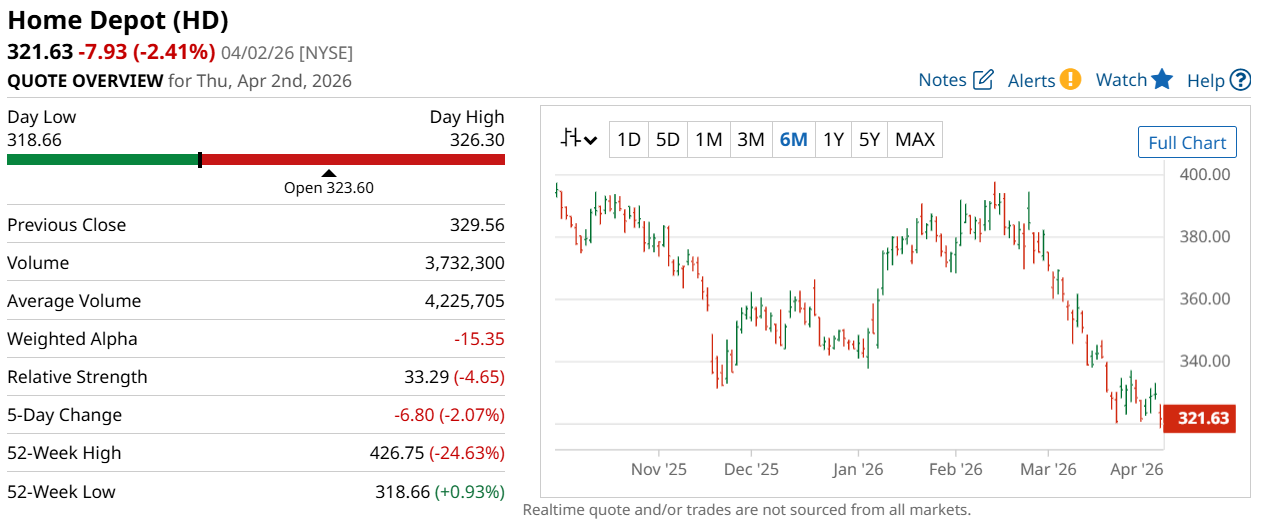
Home Depot’s share price is now sitting more than 24% below its 52‑week high, bringing its valuation closer to long‑term averages.
With sentiment depressed and the stock trading near its 52‑week low, investors may see an attractive entry point if they believe housing‑related demand and big‑box retail spending will normalize over the next cycle.
HD BULL PUT SPREAD
Today, we’re going to look at a bull put spread trade, but instead of using a regular monthly expiration, we will look at a longer-term trade.
Longer-term option trades tend to move a little slower than shorter-term trades. That allows more time to adjust or close, but also means a lower annualized return.
As a reminder, a bull put spread is a bullish trade that also can benefit from a drop in implied volatility.
The maximum profit for a bull put spread is limited to the premium received while the maximum potential loss is also capped. To calculate the maximum loss, take the difference in the strike prices of the long and short options, and subtract the premium received.
Implied volatility is currently sitting at 29.74% which gives HD an IV Percentile of 84% and an IV Rank of 38.33%.
To create a bull put spread, we sell an out-of-the-money put and then by a put further out-of-the-money.
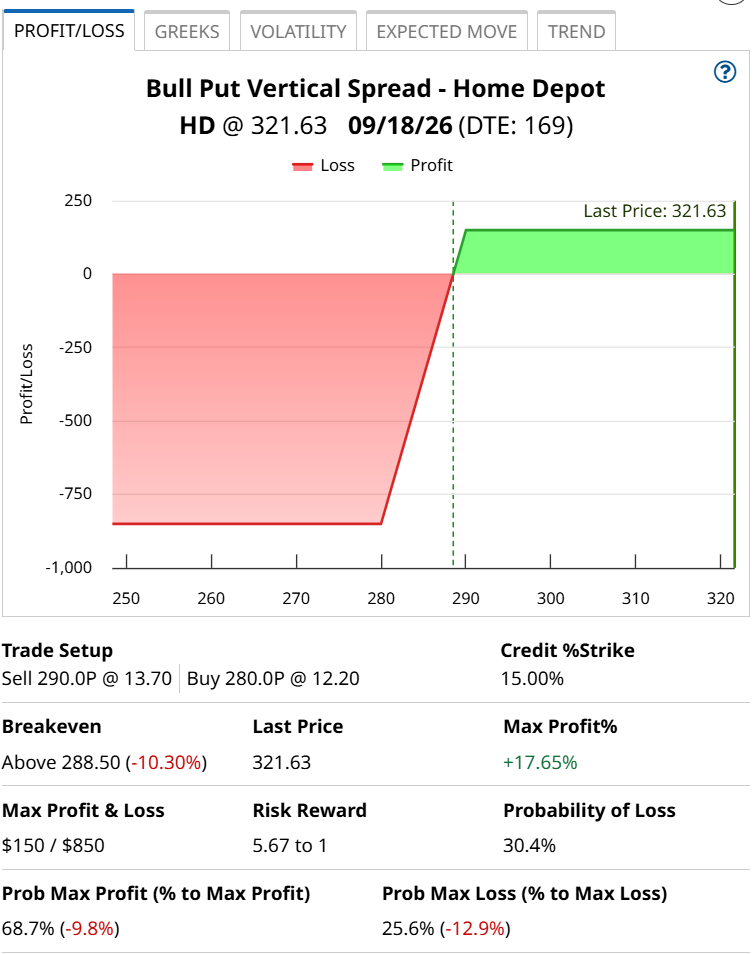
If we go out to September, we could sell the September 18 put with a strike price of $290 and buy the $280 put, which would create a bull put spread.
This spread was trading on Thursday for around $1.50. That means a trader selling this spread would receive $150 in option premium and would have a maximum risk of $850.
That represents a 17.65% return on risk between now and September 18 if HD stock remains above $290.
If HD stock closes below $280 on the expiration date the trade loses the full $850.
The breakeven point for the bull put spread is $288.50 which is calculated as $290 less the $1.50 option premium per contract.
That breakeven price is around 10.30% below Thursday’s closing price.
Conclusion And Risk Management
One way to set a stop loss for a bull put spread is based on the premium received. In this case, we received $150, so we could set a stop loss equal to the premium received, or a loss of around $150.
Another way to manage the trade is to set a point on the chart where the trade will be adjusted or closed. That could be if the stock breaks through the key level of $300, which is the below the current level of support.
Please remember that options are risky, and investors can lose 100% of their investment.
This article is for education purposes only and not a trade recommendation. Remember to always do your own due diligence and consult your financial advisor before making any investment decisions.
On the date of publication, Gavin McMaster did not have (either directly or indirectly) positions in any of the securities mentioned in this article. All information and data in this article is solely for informational purposes. For more information please view the Barchart Disclosure Policy here.
More news from Barchart