When you write as much as I do and think constantly about market integration, which I do, this is what happens. You write a story that covers a handful of major market index exchange-traded funds (ETFs), from SPDR S&P 500 ETF Trust (SPY) to Invesco QQQ Trust (QQQ) and others. You see the article published. But there’s some unfinished business. This article aims to finish that business.
It's QQQ I’m talking about. It is one of many “flat return” indexes over the past six months. However, the part left unsaid (by me) is that QQQ trading flat for half a year is not the same as other indexes doing so. Because QQQ is the GOAT of modern stock market investing — the greatest of all time.
Not in terms of performance, since segments of the tech sector have outperformed this conglomerate index of mostly tech and a smattering of others. It is the popularity, the iconic nature of QQQ, that is my focus. As Benjamin Graham, the late, great value investor and Warren Buffett’s professor, famously said: “In the short run, the market is a voting machine; in the long run, a weighing machine.”
Why Did QQQ Stop Gaining Votes?
As we see here, QQQ has had plenty of ups and downs over the past six months, but net-net, nothing. Stock market veterans like me don’t tend to think too hard about things like this. We didn’t used to, anyway.
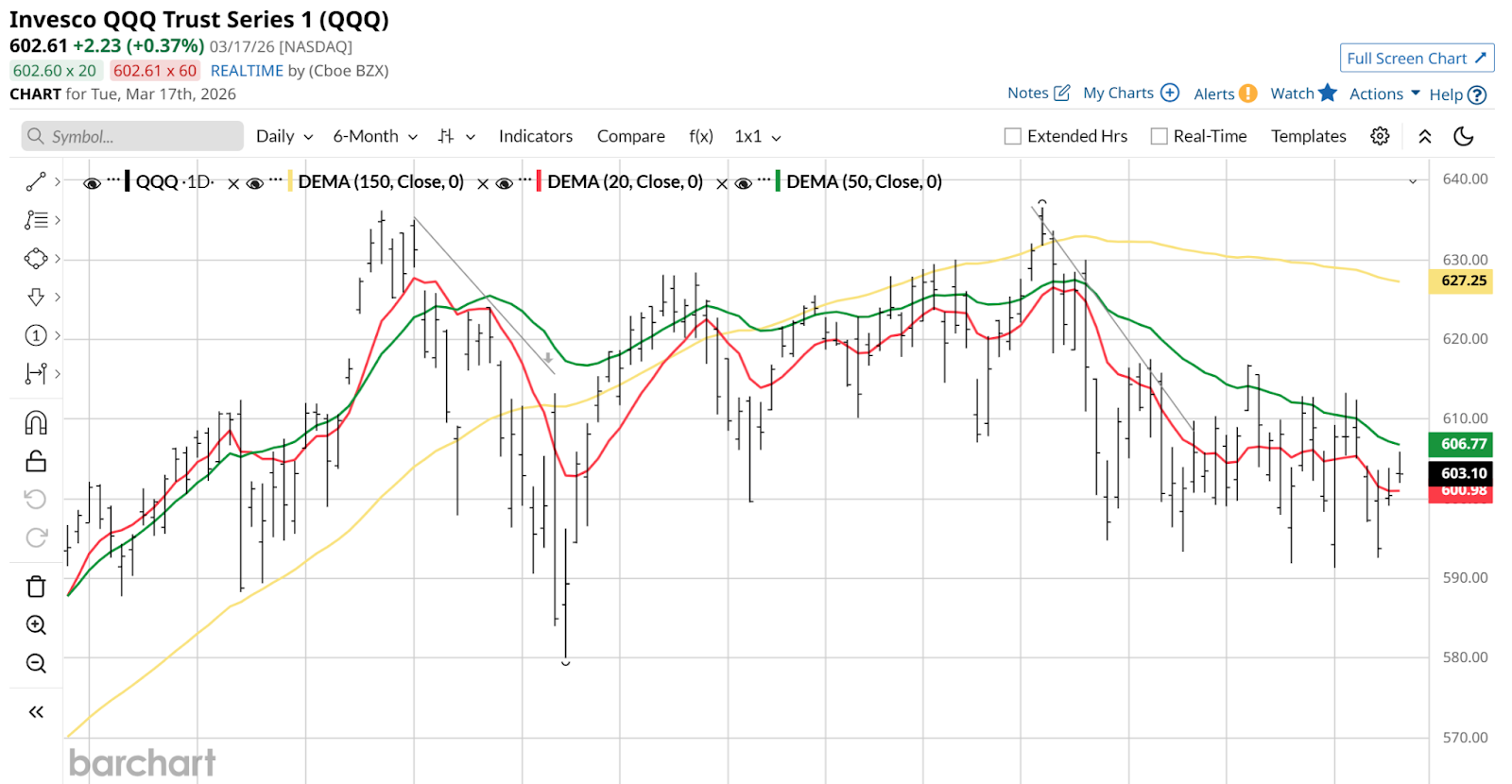
But the markets of today are so emotional, so much a voting machine, it begs the question: How long can this go on before people start talking about it? Then, more people. Then, it becomes a reverse of the self-fulfilling prophecy that was the latest phase of the artificial intelligence (AI) bubble.
The AI ‘Pull-Forward’ Trap: When the Future Becomes a Liability
QQQ is currently at a dangerous crossroads. This lack of progress is masking a fundamental shift: the AI upside that once felt like a multi-year runway appears to have been aggressively pulled forward into today's prices.
Translation: If the market thought the prices of leading AI stocks would have doubled in four years, and they double in two years, the proverbial dog has caught the car. Now, what does the dog do?
The risk of disappointment is rising by the week because the market has transitioned from pricing in potential to demanding proof. While the hyperscalers are doubling down with more than $520 billion in AI-related capital expenditures for 2026, the broader market is beginning to question the immediate return on that investment. Yes, I have seen this movie before — in the year 2000. It wasn’t the same, but it’s similar enough to raise some questions.
The infrastructure build-out remains robust. However, the application layer, the software and services that are supposed to pay for all those chips, is struggling to show a clear path to profit. Each investor can decide for themselves how much they want to bet on the future. It could turn out wonderfully, or it could be a trap.
This also explains why younger investors are more likely to be the former, more bullish camp. They have less money and more time. For us boomers? Not so much. It’s too late to go and make it all over again. That doesn’t mean, “no AI stocks for me.” It simply implies lower position weights and exposure than our children may aspire to.
The current flat return of QQQ over the past six months is not a sign of stability, but rather a structural stalemate. With investors already having borrowed future growth to justify current prices, the risk is a more permanent cooling of the AI fever. For QQQ, the path of least resistance appears to be lower until the fundamentals can finally catch up to the hype.
QQQ Has Not Exactly Been ROAR-ing Lately
My ROAR score is, as any other indicator, not perfect. But it has been a solid guide through QQQ’s recent six-month malaise. The score currently sits at 20, which indicates solid higher-than-normal risk. It last signaled lower-than-normal risk (a score of 70 or higher) on Nov. 10, 2025, when QQQ was at $623. It has waffled between yellow (average risk) and red since that time.
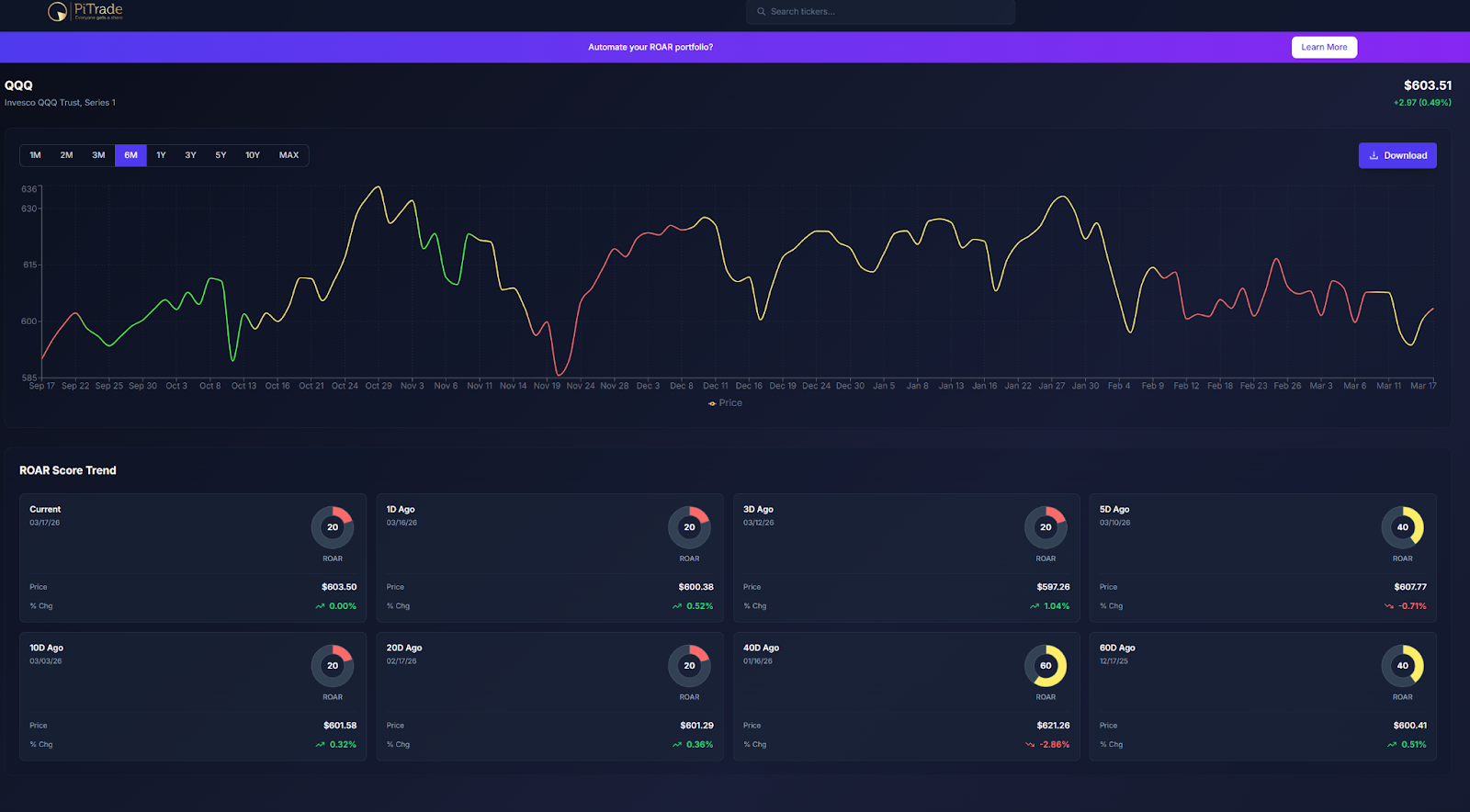
Given that QQQ is off more than 3% since that last green reading more than four months ago, I think it is doing what it aims to here. Specifically, telling a story of weakening price strength, but not yet at the point where all is lost. Risk is borderline average-to-high, depending on the week. That’s the stock market doing its thing.
QQQ: Levels to Watch From Here
I don’t often present this view of an ETF or stock, but I will here because it is perfect for the subject.
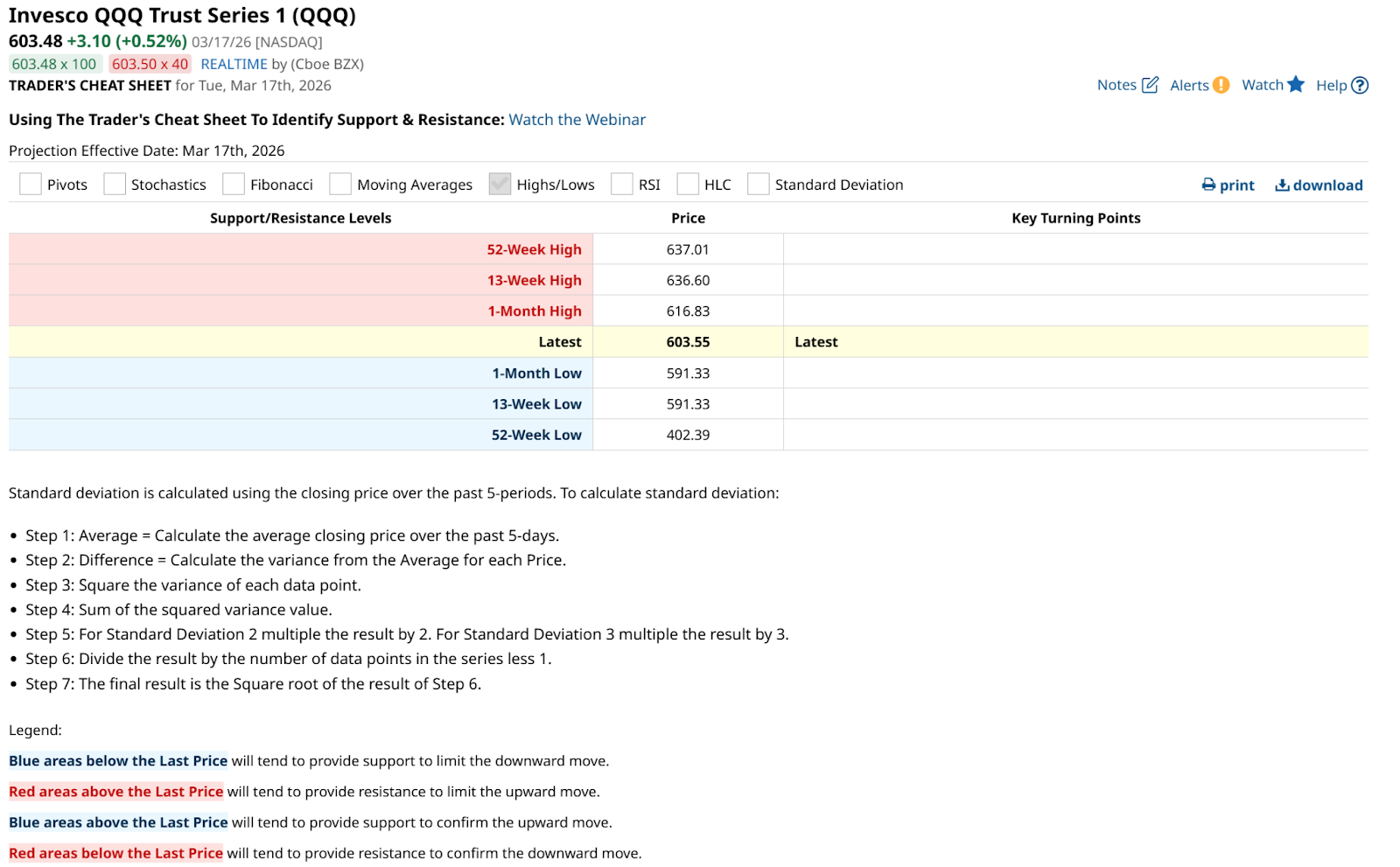
To believe this is something other than a topping process, I need to see QQQ not only cross through that $637 level, but comfortably above it. $650 is a round number I’ll look for here, about 2% above the all-time high from late January. However, it is also important to consider that it peaked at a very similar level back in late October. So from Halloween through St. Patrick’s Day, not much QQQ profit to drink to.
The downside is more about seeing both declining prices and a pickup in urgency. That is, dips are no longer bought. We’re not there yet. $591 is a stat on that table above, but my eye is on $580, the Thanksgiving-week low.
Again, applying the logic that a break needs to be more than crossing a thin line in the sand, lands me on the $570 area. Based on my experience, if we see QQQ dive under $580, the rally liftoff points from last summer, in the $550 to $560 range, could come up quickly behind it.
Anything short of a clear panic-stricken market environment, and we have to use the old rule. A trend remains in place until it doesn’t. For now, QQQ is trendless. The thrill is gone. But before we rule out yet another revival of what has been three and a half years of historic animal spirits, the best thing to do is manage risk tightly. And put investment process over guessing.
Rob Isbitts created the ROAR Score, based on his 40+ years of technical analysis experience. ROAR helps DIY investors manage risk and create their own portfolios. For Rob's written research, check out ETFYourself.com.
On the date of publication, Rob Isbitts did not have (either directly or indirectly) positions in any of the securities mentioned in this article. All information and data in this article is solely for informational purposes. For more information please view the Barchart Disclosure Policy here.
More news from Barchart
- Add Global Exposure to Your Portfolio with This 1 Norwegian ETF
- Is the Thrill Gone in QQQ? Where Investors Should Be Looking Now.
- The Growing Risk in Private Credit: Why BlackRock and JPMorgan Are Raising Alarms
- Most Stocks Aren’t Worth the Risk: Try This Simple 2-ETF Portfolio to Outperform Instead