The Falcon-246CRS brings Onsemi's HyperLux™ LH AR0246 sensor, featuring native 120dB eHDR, Adaptive Local Tone Mapping, LI-HDR, eDR, and Wake-on-Motion, to a compact, USB-powered UVC module rated −40°C to 85°C for wearables, facial recognition, smart security, dashcams, kiosks, and low-power embedded deployments.
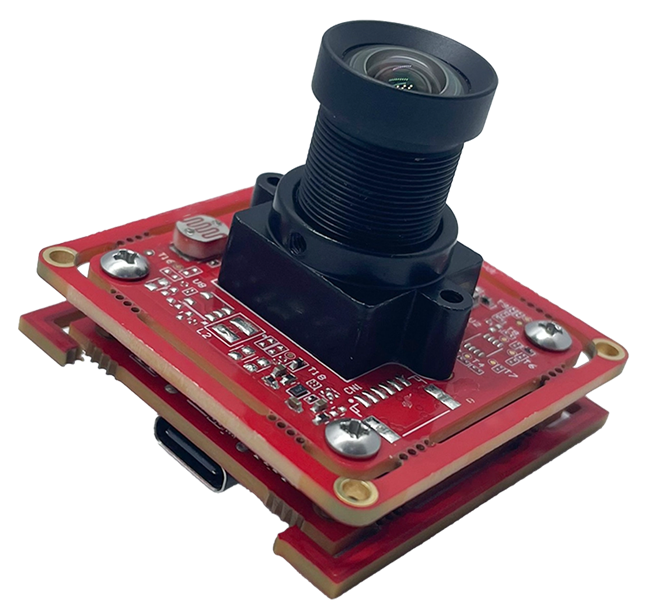
FORT WORTH, TX / ACCESS Newswire / June 5, 2026 / Vadzo Imaging today announced the launch of the Falcon-246CRS, a 2MP 1080p HDR USB 3.0 camera built on the Onsemi HyperLux™ LH AR0246 image sensor. The Falcon-246CRS delivers 120dB electronic HDR, Adaptive Local Tone Mapping, LI-HDR, enhanced dynamic range, and Wake-on-Motion in a compact USB-powered module, bringing high dynamic range 1080p USB camera performance to always-on embedded applications that cannot tolerate the power consumption, size, or integration complexity of larger sensor platforms.
The AR0246 is Onsemi's HyperLux™ LH sensor, the LH designation denoting the Low-power High-dynamic-range configuration in the HyperLux family. Its 2.0µm pixel in a 1/4" optical format delivers a sensor footprint small enough for wearable and badge camera integrations, while its on-sensor eHDR architecture captures 120dB of dynamic range natively without multi-frame blending, without host-side tone mapping processing, and without the motion ghosting that software HDR introduces on fast-moving subjects at high-contrast scene transitions.
Adaptive Local Tone Mapping is the feature that translates raw 120dB dynamic range into perceptually correct, display-ready output. Where global tone mapping applies a single compression curve to the entire frame, preserving either highlights or shadows but rarely both, ALTM divides the scene into local zones and applies region-specific tone curves. The result is simultaneous detail in bright outdoor zones and shadow-zone features within the same 1080p frame, without clipping, without haze in the shadow recovery zone, and without the unnaturally flat look that global tone mapping produces on mixed-lighting scenes.
Wake-on-Motion addresses the other side of the always-on use case: power consumption between events. An embedded camera in a smart security installation, a wearable badge camera, or a kiosk facial recognition terminal spends the majority of its operational time watching an empty scene. The AR0246's Wake-on-Motion keeps the sensor in a low-power monitoring state and triggers full-resolution capture only when motion exceeds a configurable threshold, dramatically reducing average system power without reducing responsiveness.
The Falcon-246CRS is UVC-compliant over USB 3.2 Gen 1 Type-C (backward compatible to USB 2.0), bus-powered with no external supply, and rated −40°C to 85°C, covering automotive, outdoor, and industrial deployment temperature ranges. GPIO connector support enables hardware trigger integration. The VISPA ARC SDK provides programmatic access to non-UVC features including ROI configuration, Smart GPIO, and secure firmware updates on Windows, Linux, and Android.
Key Specs: Sensor: Onsemi HyperLux™ LH AR0246 | Resolution: 2MP - 1920 × 1080 | HDR: 120dB eHDR native | Tone mapping: ALTM - Adaptive Local Tone Mapping | HDR modes: eHDR · LI-HDR · eDR | Video: 1080p · 720p · VGA | Interface: USB 3.2 Gen 1 Type-C · UVC | Wake-on-Motion | Compliance: UVC · RoHS 3 · REACH
Key imaging features
eHDR - 120dB on-sensor HDR: Native 120dB electronic HDR captured in a single exposure on the AR0246 sensor, no multi-frame blending, no motion ghosting on fast-moving subjects, no host-side HDR processing required. The camera delivers a tone-mapped output frame directly over USB, ready for display or inference without additional ISP pipeline stages on the host.
ALTM - Adaptive Local Tone Mapping: Region-specific tone curve application across the frame, not a single global compression curve. ALTM preserves detail simultaneously in bright outdoor zones and deep shadow areas within the same 1080p frame, delivering perceptually correct output under high-contrast mixed-lighting scenes without the haze or flatness of global HDR tone mapping.
LI-HDR & eDR: LI-HDR (Low-motion Interleaved HDR) provides an additional multi-exposure HDR mode for static or low-motion scenes where maximum dynamic range extraction is prioritized over motion artifact avoidance. Enhanced Dynamic Range (eDR) extends scene coverage beyond the native single-exposure range using intra-frame exposure control, three HDR modes covering the full range of deployment lighting conditions making Falcon-246CRS a formidable high dynamic range camera.
Wake-on-Motion: The AR0246 monitors the scene in a low-power state and triggers full-resolution 1080p capture when scene motion exceeds a configurable threshold. For always-on deployments such as wearable badge cameras, smart security terminals, kiosk facial recognition, this eliminates continuous full-power sensor operation during idle periods, reducing average system power without reducing responsiveness to motion events.
Ultra-low power - HyperLux™ LH architecture: The HyperLux™ LH designation reflects Onsemi's Low-power High-dynamic-range pixel design. The AR0246's 2.0µm pixel in 1/4" format draws significantly less power than larger-format HDR sensors while delivering 120dB dynamic range, enabling battery-powered wearables and bus-powered USB deployments where thermal envelope and power consumption are constrained.
−40°C to 85°C operating range: Full industrial and automotive temperature qualification from −40°C cold-start to 85°C continuous operation, covering dashboard-mounted dashcams, outdoor smart city cameras, vehicle cabin installations, and industrial kiosks where ambient temperatures exceed the range of standard embedded camera modules rated to 70°C.
Applications
Wearable & badge camera: The Falcon-246CRS is a low-power HDR USB camera for wearables and body-worn badge cameras, combining the AR0246's compact form factor, bus-powered operation, Wake-on-Motion, and 120dB HDR to deliver always-on incident documentation without a dedicated power source and without continuous full-power sensor operation during idle periods. Body-worn cameras for security personnel, industrial workers, and field technicians face two constraints standard cameras cannot meet simultaneously: battery life and image quality in high-contrast environments. Wake-on-Motion keeps the Falcon-246CRS in a low-power monitoring state between events. When motion is detected, full 1080p HDR capture activates within milliseconds. ALTM ensures video captured at a sun-lit site entrance simultaneously shows the subject's face and the bright outdoor background without clipping either.
Facial recognition & access control: The Falcon-246CRS is a 1080p HDR USB camera for facial recognition that captures usable face images at access control gates, building entrances, and secure checkpoints in high-contrast lighting, where backlit subjects against bright outdoor backgrounds or underlit indoor lobbies cause standard cameras to produce silhouettes or overexposed frames that defeat recognition algorithms. Facial recognition requires adequate pixel coverage of the face across the dynamic range of the scene, a correctly exposed face in a backlit doorway needs 40-60dB more dynamic range than the sensor's typical operating point. The AR0246's 120dB eHDR with ALTM simultaneously resolves face detail and background highlights. Wake-on-Motion activates recognition capture only when a subject enters the frame, reducing false trigger processing load on the inference host.
Smart security & surveillance: The Falcon-246CRS is a 2MP high dynamic range USB camera for smart security and surveillance that maintains clear video across the full day-night cycle and at scene transitions where single-exposure cameras lose subject detail at contrast extremes. Smart security cameras that feed AI analytics require consistent frame quality across all lighting conditions, a model trained on correctly exposed frames fails on silhouetted or overexposed inputs. The AR0246's eHDR produces correctly tone-mapped frames at every illuminance level from indoor lobby to direct sunlight without changing camera settings. Wake-on-Motion reduces storage and bandwidth requirements by triggering recording only on scene activity.
Dashcam & fleet telematics: The Falcon-246CRS is a 1080p HDR USB dashcam camera that captures clear video at tunnel exits, oncoming headlights at night, and direct sun on road surfaces, using 120dB eHDR and ALTM to hold detail in both the bright sky and the road markings simultaneously, without the motion ghosting that multi-frame HDR dashcam systems produce on fast-moving vehicles. Fleet dashcams capturing driver-facing and road-facing video face extreme contrast at dawn and dusk transitions. The AR0246's single-exposure 120dB HDR eliminates the transition artifact where multi-exposure dashcams produce a brief low-quality frame during scene brightness changes. The −40°C to 85°C operating range covers full automotive cabin temperature requirements. Bus-powered USB operation simplifies vehicle integration without a dedicated power regulator.
Kiosk & digital signage: The Falcon-246CRS is a low-power 1080p HDR USB camera for kiosk and digital signage applications that captures clear user images under the mixed lighting of retail, banking, and public service kiosks where overhead LED panels, display backlights, and window daylight create contrast conditions that standard 1080p cameras cannot expose correctly. Kiosk cameras run continuously but spend the majority of their time watching empty screens. Wake-on-Motion activates the Falcon-246CRS to full-resolution capture only when a user approaches, reducing continuous power draw in installations where hundreds of kiosk units run 24 hours. ALTM resolves the user's face detail against bright display backgrounds simultaneously. The 32×32mm form factor fits slim kiosk bezel installations.
Smart city & traffic monitoring: The Falcon-246CRS is a 2MP high dynamic range USB camera for smart city and traffic monitoring applications that maintains clear video at intersections and transit nodes across the full day-night illuminance cycle, capturing pedestrian detail in shadow zones alongside vehicle headlights in the same frame under the AR0246's 120dB eHDR. Smart city camera deployments require sensors that operate unattended across wide temperature ranges and variable outdoor lighting without field maintenance. The −40°C to 85°C operating range covers all climatic conditions. Bus-powered USB operation simplifies installation at nodes without dedicated power circuits. The compact 38×38mm or 32×32mm form factor fits standard smart city enclosures.
Retail analytics: The Falcon-246CRS is a low-light HDR USB camera for retail analytics that delivers consistent 1080p frames for people counting, dwell analysis, and shelf monitoring across mixed retail lighting without the illumination-induced frame quality variation that degrades analytics model confidence. Retail analytics algorithms require consistent input frame quality across store operating hours. Morning window light, midday mixed ambient, and evening artificial lighting present different contrast conditions to a standard camera. The AR0246's eHDR and ALTM produce consistent tone-mapped output regardless of scene illuminance, keeping analytics confidence scores stable across all operating hours. Wake-on-Motion triggers capture during customer activity periods, reducing compute load during off-hours.
UAV, drone & AGV vision: The Falcon-246CRS is a low-power 1080p HDR USB camera for UAVs, drones, and AGVs where payload weight, bus power budget, and high-contrast outdoor-to-indoor transitions are simultaneous constraints that standard cameras cannot meet without dedicated power management hardware. Drone and AGV vision platforms operate on tight power budgets, the bus-powered Falcon-246CRS adds minimal payload without a dedicated power regulator. Moving from outdoor to indoor operation transitions from direct sun to artificial light across a large dynamic range; the AR0246's 120dB eHDR handles this without requiring exposure mode changes or causing the brief low-quality frames that single-exposure cameras produce during transitions. UVC compliance enables direct integration with companion computer stacks on Jetson and Raspberry Pi.
"The HyperLux™ LH designation tells the design story: low power and high dynamic range in the same pixel. Wake-on-Motion, 120dB eHDR, and ALTM in a 13-gram bus-powered module opens HDR 1080p imaging to applications such as wearables, kiosks, drones where previous HDR solutions were too large, too power-hungry, or too complex to integrate." - Alwin Vincent, Product Management Team, Vadzo Imaging
Frequently Asked Questions
What is the Onsemi HyperLux AR0246 sensor and what makes it different from other 1080p sensors?
The Onsemi HyperLux™ LH AR0246 is a 2MP 1080p CMOS image sensor in Onsemi's HyperLux family delivering 120dB native electronic HDR, Adaptive Local Tone Mapping, and Wake-on-Motion in a 1/4" format with 2.0µm pixels, designed for always-on embedded vision applications where standard 1080p sensors cannot achieve simultaneously low power and high dynamic range. Most 1080p sensors either deliver adequate dynamic range at standard power consumption, or require high power for advanced HDR modes. The AR0246's HyperLux LH architecture achieves 120dB HDR with on-sensor tone mapping while maintaining a power profile suitable for bus-powered USB operation and battery-powered wearables. Compared to the AR0233 (which is Onsemi's higher-power 1080p HDR sensor), the AR0246 trades some peak HDR performance for significantly lower power consumption and the addition of Wake-on-Motion.
What is Adaptive Local Tone Mapping (ALTM) and why does it produce better HDR results than standard tone mapping?
Adaptive Local Tone Mapping (ALTM) divides the camera frame into local regions and applies a region-specific tone curve to each zone. Standard global tone mapping applies one compression curve to the entire image, which preserves highlights at the expense of shadows or vice versa. In a high-contrast scene global tone mapping either clips the outdoor sky to keep indoor detail, or lifts the shadows at the expense of blown-out highlights. ALTM applies a locally adapted curve: the bright outdoor zone receives heavy compression to preserve sky detail, while the shadow zone receives a brighter curve to recover face detail, and the transition between zones is blended to avoid banding artifacts. The output frame is perceptually correct across the full scene without the haze, flatness, or unnatural appearance of aggressive global HDR compression. For facial recognition and access control, this means face quality scores are consistent whether the subject is backlit or front-lit.
How does Wake-on-Motion work on the Falcon-246CRS and how much power does it save?
Wake-on-Motion on the Falcon-246CRS keeps the AR0246 sensor in a low-power monitoring state between activity events, activating full-resolution 1080p HDR capture only when detected scene motion exceeds a configurable threshold, reducing average system power consumption significantly in always-on deployments where the camera watches an empty scene for the majority of its operating time. The AR0246 monitors the scene at reduced resolution and frame rate in its low-power state, consuming a fraction of the power required for full 1080p HDR streaming. When motion is detected the sensor transitions to full-resolution capture within milliseconds. The Wake-on-Motion threshold is configurable via the VISPA ARC SDK, allowing the application to tune sensitivity to the specific deployment environment. For a kiosk camera operating 16 hours per day with 2 hours of actual user activity, Wake-on-Motion can reduce average sensor power to a fraction of continuous-operation levels.
What is the difference between eHDR, LI-HDR, and eDR on the AR0246?
eHDR (electronic HDR) is the primary 120dB single-exposure HDR mode using the AR0246's native pixel architecture recommended for scenes with motion. LI-HDR (Low-motion Interleaved HDR) uses multi-exposure interleaving for maximum dynamic range on static or low-motion scenes. eDR (enhanced Dynamic Range) extends single-exposure dynamic range beyond the sensor's base using intra-frame exposure control, with lower processing overhead than full eHDR. The three modes represent a spectrum of dynamic range versus motion tolerance trade-offs. eHDR captures 120dB in a single pixel exposure event. This is the correct mode for access control, dashcams, and wearables where subjects are always moving. LI-HDR interleaves multiple exposures to extract maximum dynamic range from static scenes where motion artifact is not a concern. eDR is a middle ground: extended dynamic range with minimal processing overhead, suited to scenes with moderate contrast where full eHDR processing is unnecessary. All three modes are available on the Falcon-246CRS and selectable via the VISPA ARC SDK.
Is the Falcon-246CRS compatible with Linux, ROS2, and OpenCV without drivers?
Yes. The Falcon-246CRS is a UVC-compliant USB 3.0 camera that enumerates as a standard /dev/video0 device on Linux, compatible with V4L2, ROS2 usb_cam, OpenCV VideoCapture, and GStreamer on any UVC-capable Linux kernel without proprietary drivers or kernel modules. UVC compliance means the camera uses the built-in uvcvideo kernel driver present in all mainstream Linux distributions and Android builds. On ROS2, the usb_cam package publishes sensor_msgs/Image topics at the configured resolution immediately on connection. The camera is backward compatible to USB 2.0, enabling integration on hosts with only USB 2.0 ports without hardware changes at reduced bandwidth, VGA and 720p modes operate at full frame rate on USB 2.0. The VISPA ARC SDK provides programmatic access to non-UVC features such as HDR mode selection, Wake-on-Motion configuration, ROI, Smart GPIO, and firmware updates via C, C++, and Python APIs on Windows, Linux, and Android.
How does the Falcon-246CRS compare to the Falcon-3C10CRS (OX03C10) for HDR applications?
The Falcon-246CRS (AR0246) offers lower power consumption, Wake-on-Motion, and a smaller 1/4" form factor and is optimized for always-on wearables, kiosks, and bus-powered deployments. The Falcon-3C10CRS (OX03C10) delivers higher 140dB HDR, LED Flicker Mitigation, and a wider −40°C to 105°C operating range which is optimized for automotive, high-speed LED-lit environments, and fleet telematics. Both cameras deliver 1080p HDR over USB 3.0 with UVC compliance, but they target different deployment priorities. The AR0246 HyperLux LH's core advantage is the combination of low power, small format, and Wake-on-Motion, the right sensor when the camera spends most of its time idle and power budget is constrained. The OX03C10's core advantage is 140dB dynamic range (20dB more than the AR0246), LED Flicker Mitigation for LED-dense environments, and 105°C thermal ceiling. For applications that require both low power and maximum HDR, the AR0246 is the appropriate selection; for applications that require maximum HDR and LED flicker immunity, the OX03C10 is preferred.
Availability
The Falcon-246CRS 2MP AR0246 HyperLux™ 1080p HDR USB 3.0 Camera is available now for evaluation and volume production. Evaluation units ship with a factory-fitted M12 S-Mount lens (74° DFOV), USB 3.2 Gen 1 Type-C cable, and integration documentation. The camera is available in 38×38mm and 32×32mm board form factors with optional enclosure configurations. OEM customization such as lens selection, board redesign, NIR and LED array integration, enclosure design, and firmware modification is available on request. Contact Vadzo Imaging at support@vadzoimaging.com or visit www.vadzoimaging.com.
About Vadzo Imaging
Vadzo Imaging develops high-performance embedded and machine vision camera for OEMs and system integrators building next-generation intelligent systems. The company delivers imaging platforms across USB, MIPI, GigE, Wi-Fi, and SerDes interfaces, supporting applications in industrial automation, robotics, smart surveillance, smart city infrastructure, and edge AI. Beyond hardware, Vadzo provides end-to-end imaging expertise, including sensor integration, ISP tuning, firmware development, embedded camera optics characterization, and OEM camera customization services that accelerate development and deployment at scale.
Media Contact
Alwin Vincent
Vadzo Imaging
Email: alwin@vadzoimaging.com
LinkedIn: Vadzo Imaging
YouTube: Vadzo Imaging
X: Vadzo Imaging
SOURCE: Vadzo Imaging
View the original press release on ACCESS Newswire