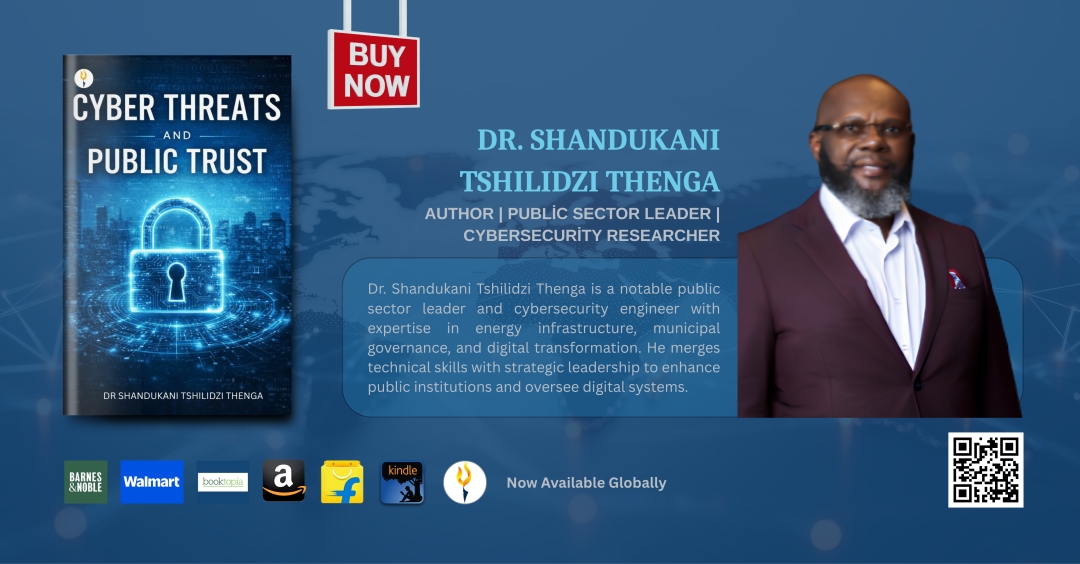
In an era where cyberattacks increasingly threaten public services, citizen data, and government operations, Dr. Shandukani Tshilidzi Thenga has released a powerful new book designed to reshape how leaders think about cybersecurity.
Titled Cyber Threats and Public Trust, the book provides a comprehensive examination of the relationship between digital resilience, governance, leadership, and public confidence.
Cybersecurity incidents continue to impact organizations across the globe, affecting everything from financial systems and healthcare services to municipal operations and critical infrastructure. While technology often receives the majority of attention, Dr. Thenga argues that successful cyber resilience begins with leadership.
The book challenges traditional assumptions by positioning cybersecurity as a governance issue rather than solely a technical discipline. Through practical examples and accessible explanations, readers gain a deeper understanding of how institutional decisions influence vulnerability, preparedness, and recovery.
"Technology alone cannot solve cybersecurity challenges," explains Dr. Thenga. "Institutions must develop cultures of accountability, awareness, and resilience if they hope to protect the services their communities rely upon."
Throughout the book, readers are guided through key aspects of the cyber threat landscape, including phishing attacks, ransomware campaigns, malware infiltration, service disruptions, and governance failures. The discussion extends beyond technical mechanics to examine how organizational structures, policy decisions, and leadership approaches shape cyber outcomes.
A significant focus is placed on public institutions and municipalities, which face unique challenges due to budget limitations, aging infrastructure, increasing digital dependence, and public accountability obligations.
The book highlights how cyber incidents can create far-reaching consequences beyond technology. Service interruptions, delayed operations, financial pressures, reputational harm, and declining public trust can persist long after systems have been restored.
Dr. Thenga's professional background in engineering, municipal leadership, renewable energy, and cybersecurity research provides a unique perspective on these challenges. His multidisciplinary expertise enables him to bridge the gap between technical realities and governance responsibilities.
Unlike many cybersecurity publications aimed exclusively at specialists, Cyber Threats and Public Trust is written for a broad audience. Government officials, executives, managers, policymakers, students, and professionals can all benefit from its practical insights and leadership-focused approach.
The book also emphasizes the importance of moving from reactive responses to proactive stewardship. Organizations that understand cyber resilience as an ongoing responsibility are better equipped to anticipate threats, manage risks, and maintain public confidence.
As governments and institutions continue to expand their digital capabilities, the need for effective cyber governance has never been greater. Cyber Threats and Public Trust offers a timely and relevant resource for leaders seeking to understand their role in safeguarding digital infrastructure and public trust.
The publication stands as both a practical guide and a call to action, encouraging organizations to rethink how they approach cybersecurity in a rapidly evolving digital environment.
Cyber Threats and Public Trust is now available worldwide.
Media Contact
Company Name: Hemant Bansal
Contact Person: Hemant Bansal
Email: Send Email
Phone: 8895095404
Country: India
Website: verseskindlerpublication.com